Worth Matravers
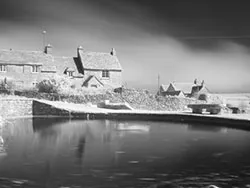
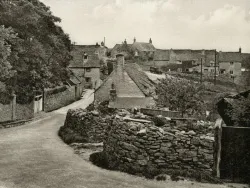
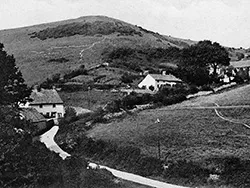
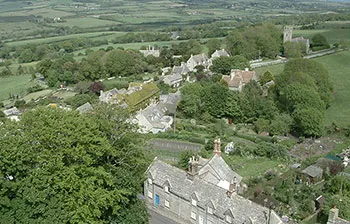
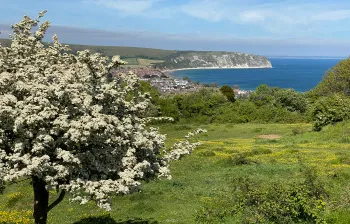
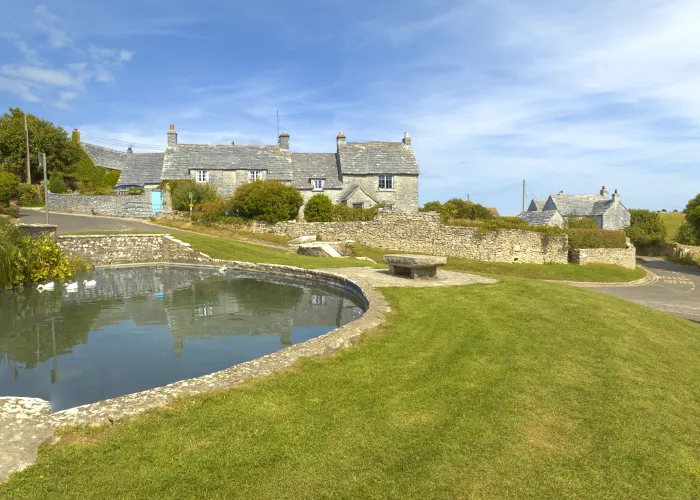
A perfect huddle of grey stone cottages around a duck pond, high above the Purbeck cliffs, a tiny village with a giant place in the history of medicine, science and stone.
Visit Worth Matravers
A quintessential Purbeck village
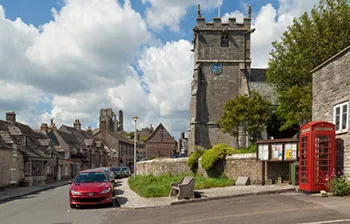
It is a tight cluster of limestone cottages and farmhouses gathered around a sloping green and a duck pond, with a Norman church on the rise above and the sea just a short walk to the south. The name "Worth" comes from an Old English word for an enclosure or homestead; the "Matravers" was added from the medieval lords of the manor. The surrounding parish covers roughly 2,600–2,700 acres of farmland, downland and dramatic coast.
For all its smallness, Worth retains a genuine working community with a village shop and a much-loved pub, and it has a remarkable history out of all proportion to its size, from a pioneering experiment in vaccination to the secret birth of radar. The whole area lies within the Dorset National Landscape, and its coast forms part of the Jurassic Coast World Heritage Site. Three industries, farming, fishing and quarrying, have shaped the village for centuries, and their marks are written all over the landscape: medieval cultivation terraces (strip lynchets) on the slopes to the north, and old stone quarries on the cliffs to the south.
A pioneer of vaccination
St Nicholas & Benjamin Jesty
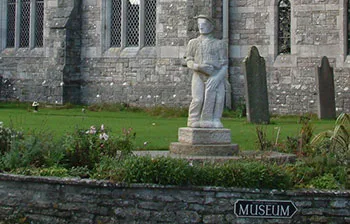
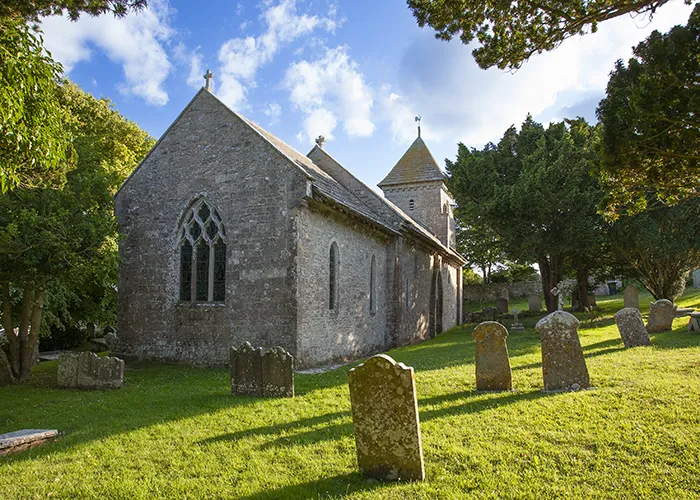
The church of St Nicholas of Myra, perched above the village, is one of the oldest in Dorset, built (or rebuilt) around 1100. Though largely Norman, with a fine nave, tower and round-arched windows, it preserves a blocked Saxon doorway hinting at an even older church on the site, and an Early English chancel added around 1300. It was sensitively restored in 1869 after falling into disrepair.
But the churchyard holds Worth's most remarkable story. Here lies Benjamin Jesty (c.1736–1816), a Dorset farmer who, in 1774, more than twenty years before Edward Jenner's celebrated experiments, deliberately inoculated his wife and two sons with cowpox to protect them against smallpox. He is widely regarded as one of the first people ever to do so. Jesty later farmed at Downshay near Worth, and his pioneering courage was finally recognised in 1805 when he was invited to London and honoured by the Vaccine Pock Institute.
His headstone, which he composed himself, modestly records that he was "the first Person (known) that introduced the Cow Pox by Inoculation." It's a quietly extraordinary memorial: the grave of a humble farmer who helped lay the foundations of a medical breakthrough that still saves countless lives.
An institution
The Square and Compass
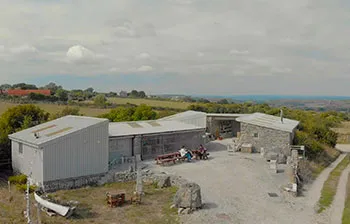
No description of Worth Matravers is complete without its pub. The Square and Compass, named for the tools of the local stonemasons, is one of the most famous and characterful pubs in England, and has been run by the same family for over a century. It is gloriously unspoilt: ales and ciders are served through a hatch rather than over a bar, and on a fine day the crowds spill out onto the stone terrace to drink in the view down to the sea.
The pub is renowned for its real ales and its own farmhouse cider, for live folk music, and for two much-loved annual festivals, a stone-carving festival and a cider festival. Tucked inside is a delightful surprise: a small private museum of fossils, ammonites and local artefacts, much of it found in the surrounding fields and cliffs, assembled over decades by the landlord's family.
Together with the village shop and café, the Square and Compass keeps Worth Matravers feeling like a living village rather than a museum piece, even on the busiest summer afternoons.
The birth of radar
The secret village
During the Second World War, this quiet village played a pivotal and secret role in the war effort. In May 1940, around 200 scientists and engineers relocated here from Dundee, setting up on Renscombe Down above the village. Within months the operation was renamed the Telecommunications Research Establishment (TRE), and it became the beating heart of British radar research.
The high, flat clifftop terrain was ideal for radar, and its distance from the obvious invasion coast made it safer than the team's earlier east-coast bases. Over two years the workforce swelled from 200 to around 2,000. Their breakthroughs, including airborne and centimetric radar, the rotating aerial and map display, and the "Gee" navigation system, helped win the Battle of Britain, counter the Blitz and guide the bomber offensive. So central was their work that the very word "boffin" is said to have grown up around them.
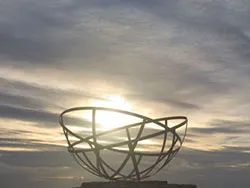
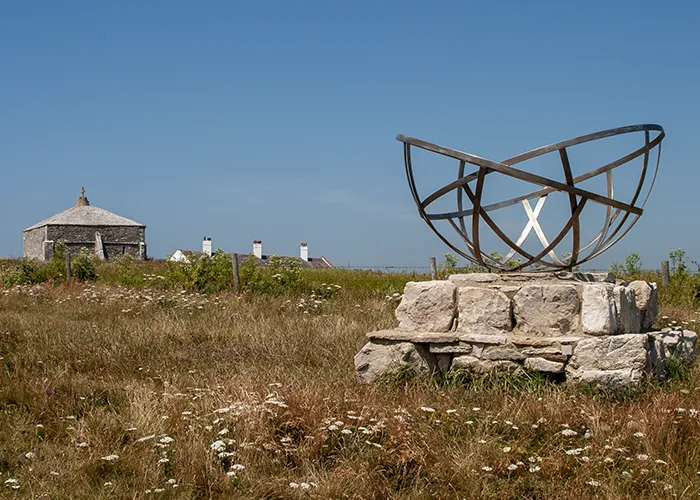
After a daring British raid on a German radar station at Bruneval in February 1942, the government feared a reprisal raid on Worth and, on Churchill's orders, moved the most secret work inland to Malvern in May 1942. Little of the site survives, but a Purbeck Radar Memorial near St Aldhelm's Head, unveiled by the radar pioneer Sir Bernard Lovell, now commemorates this remarkable chapter.
Cliffs, coves & quarries
The coast & coast path
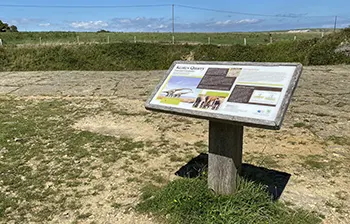
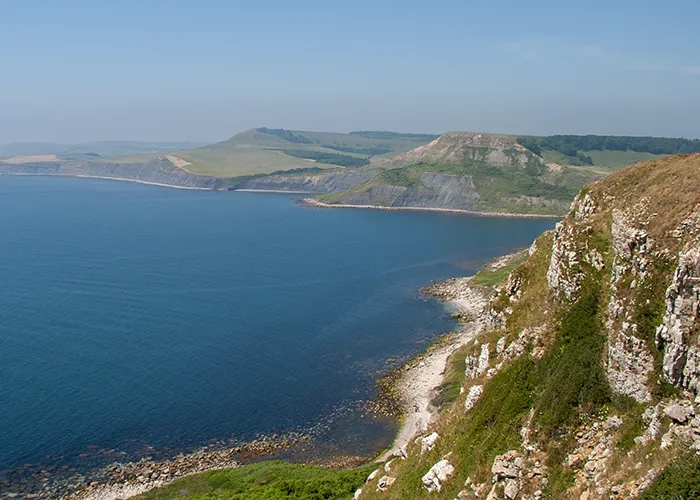
Worth Matravers is one of the finest bases for walking on the whole Jurassic Coast. The South West Coast Path runs along the cliffs just to the south, and within easy walking distance are some of Purbeck's most atmospheric spots. Winspit and Seacombe are old cliff-edge stone quarries, their cavernous galleries cut straight into the rock, wonderfully wild places that have featured as film and television locations including Dr Who and Star Wars. Chapman's Pool is a beautiful, secluded horseshoe bay, while St Aldhelm's Head (or St Alban's Head) is the dramatic, windswept southern tip of Purbeck, crowned by a tiny ancient chapel.
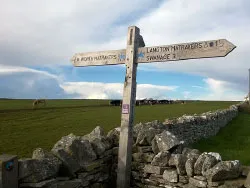
The classic outing is a circular walk from the village down a valley to the coast at Winspit, along the clifftop path, and back via the Priest's Way, the ancient track that medieval priests once walked between the churches of Worth and Swanage. The dry-stone walls of Purbeck limestone, the strip lynchets, and the old quarry workings tell the layered story of the landscape as you go.
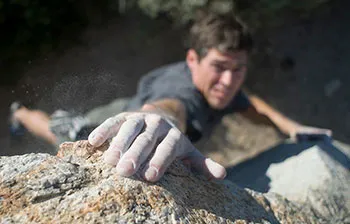
These cliffs are also a magnet for rock climbers, and the whole stretch is rich in wildlife, from seabirds and peregrines to the flowers of the limestone grassland.
Parking
Where do I park?
Worth is tiny and its lanes are narrow, so please don't drive into the village to park. There's a car park on the approach road from the Kingston–Langton road, and a rougher one near Renscombe for Chapman's Pool and the coast, both a short, scenic walk from the heart of the village.
Visiting Worth Matravers
- Location
- Heart of the Isle of Purbeck, about 4 miles W of Swanage, 3 miles S of Corfe Castle
- Parking
- Village car park on the approach road; rough car park near Renscombe for Chapman's Pool
- Don't miss
- Benjamin Jesty's grave at St Nicholas, the Square and Compass, the duck pond
- Walking
- On the South West Coast Path & Priest's Way; routes to Winspit, Seacombe & St Aldhelm's Head
- Facilities
- Village shop, café, pub; no large amenities, bring what you need for the coast
- Setting
- Dorset National Landscape; coast within the Jurassic Coast World Heritage Site
Tips before you go
- Don't try to park in the village itself, the lanes are narrow; use the signed car park on the approach road and walk in
- Worth gets very busy on sunny summer afternoons, especially around the Square and Compass, arrive early or visit off-season for a quieter experience
- The old quarries at Winspit and Seacombe are unstable and unfenced; explore the galleries with great care and keep children close
- Clifftops here are sheer and exposed, stay on the coast path, well back from the edge, and wear proper walking shoes
- Check church opening hours if you're making a special trip to see Benjamin Jesty's grave and the Norman interior
- Facilities are limited to the village shop, café and pub, so carry water and snacks for longer coastal walks
References & further reading
Sources used for the history, heritage and visitor information added to this page:
- Wikipedia, Benjamin Jesty (1774 cowpox inoculation, move to Worth, 1805 recognition)
- Britain Express, St Nicholas of Myra Church (c.1100 Norman church, Saxon doorway, Jesty's grave & epitaph)
- Wikipedia, Telecommunications Research Establishment (TRE history, 1940 move, renaming, 1942 move to Malvern)
- South West Coast Path, Worth Matravers & Renscombe (radar story, 200?2,000 workers, Bruneval, walking route)
- National Coastwatch, Radar & the Purbeck Radar Memorial (memorial dedicated by Sir Bernard Lovell)
- The Dorset Guide, Worth Matravers (village, strip lynchets, the Square and Compass)
- Dorset Council Heritage, Jesty headstones (listed graves of Benjamin & Elizabeth Jesty)