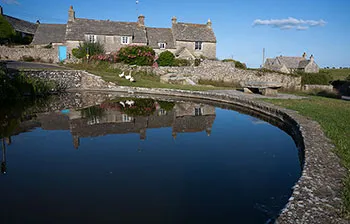
Getting There
From Wareham, take the A351 towards Corfe Castle; turn right just before the castle on the lane signposted for Church Knowle. From Corfe Castle, it is under a mile west via minor roads. Postcode: BH20 5NQ.

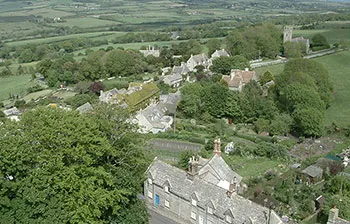
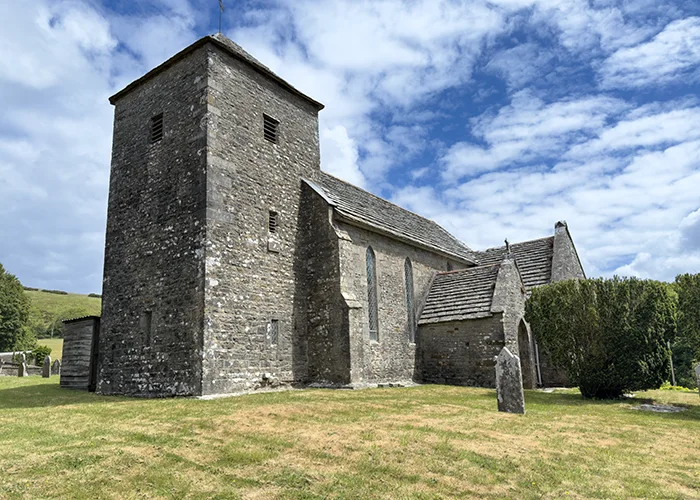
Nestled between the two ridges of the Purbeck Hills a mile west of Corfe Castle, Church Knowle is one of those Dorset villages that repays slow exploration. A 13th-century church, a medieval manor claimed to be one of England's oldest continuously inhabited houses, a pub over four centuries old, and the graves of men who brought the first steam locomotive to Purbeck, all in a settlement listed in the Domesday Book.
Church Knowle sits in a quiet valley between the Purbeck chalk ridge to the north and the limestone hills to the south, about one mile west of Corfe Castle and four miles south of Wareham.
The village name comes from the Old English cnolle, meaning a hillock or rounded hill, a fitting description of its setting between low rises on either side of the valley. The Domesday Book of 1086 records it as Cnolle, already with "a church at Chennole" and a resident priest. By 1346 it was Churchecnolle, the ecclesiastical identity firmly established. Settlement here, however, goes back much further: the surrounding landscape shows evidence of Iron Age occupation on Knowle Hill, a Roman villa has been identified nearby, and Bronze Age barrows punctuate the ridgelines.
Getting there: Church Knowle is reached via the A351 from Wareham, turn right just before Corfe Castle and follow the lane south-west for about a mile.
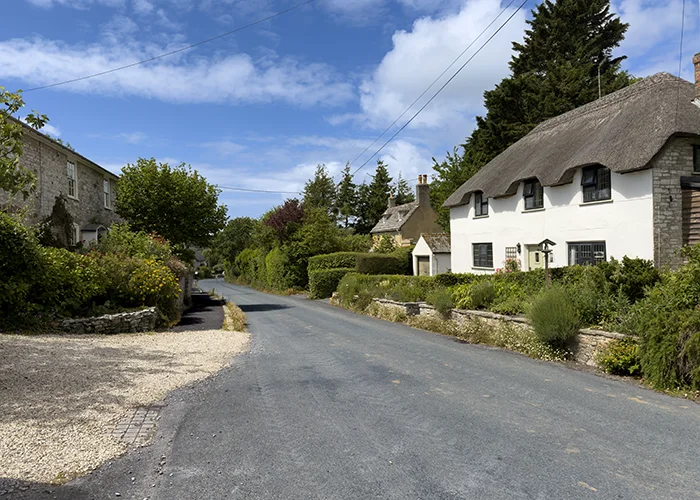
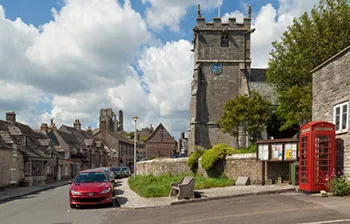
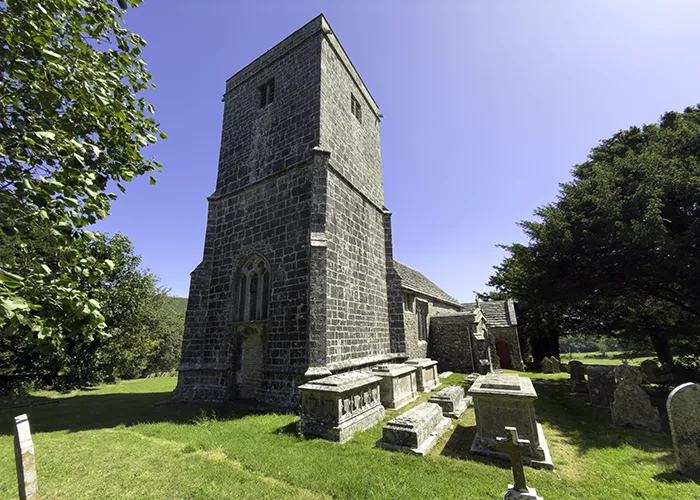
The Parish Church of St Peter is one of the oldest continuously used buildings in the Isle of Purbeck. The chancel was built around the first quarter of the 13th century, with the nave and transepts following shortly afterwards; the west tower and south porch were added in the 14th century, though the tower's upper section was rebuilt in the 18th. A north aisle was added between 1833 and 1841. Parts of the church thus represent at least seven distinct centuries of construction, 13th, 14th, 15th, 16th, 18th, 19th, and 20th, in the same Grade II* listed fabric.
The church is built of local stone rubble with Purbeck stone dressings and a stone-slate roof, characteristic of the area. Inside, a list of rectors stretches back to the 14th century. A medieval cross-slab with foliate decoration dating from around 1300 survives in the south transept, and a medieval sundial has been recorded. The Domesday Book's mention of a church here makes this one of the longest-documented ecclesiastical sites in Purbeck.
The churchyard is especially notable for what lies beneath it. The Clavell family, who owned Barnston Manor and later built Smedmore House at Kimmeridge, are commemorated here, as are the Pike brothers, whose contribution to Purbeck's industrial history was considerable (see below).
Three-quarters of a mile south-west of the village stands Barnston Manor, a Grade I listed stone farmhouse with origins in the 13th century. The house sits on the site of a former Saxon building, which itself may have replaced a Roman predecessor on the same plot. The west wing and solar block are the earliest surviving elements, retaining three blocked 13th-century lancet windows; the main hall and further alterations date from the 16th century, when the front wall was partly refaced in ashlar. Since the 16th century, no major structural changes have been made.
Barnston is recorded as a manor as early as the time of Edward the Confessor (mid-11th century). In the 16th century it was the principal home of the Clavell family, local MPs and landowners who later built Smedmore House on the coast near Kimmeridge. The manor has been described as one of the oldest continuously inhabited houses in Dorset, and by some accounts in Britain, though the qualifier "Dorset's" is the more defensible claim. Today it remains a private working farm.
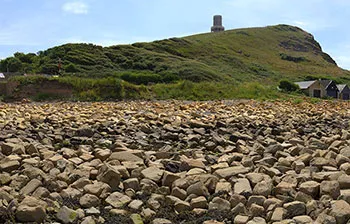
The Clavell connection extends throughout Church Knowle's history. The family's memorial is in St Peter's Church; John Clavell-Richards, a later rector of Church Knowle, built the distinctive Clavell Tower folly on the clifftop near Kimmeridge Bay (moved and restored in 2008).
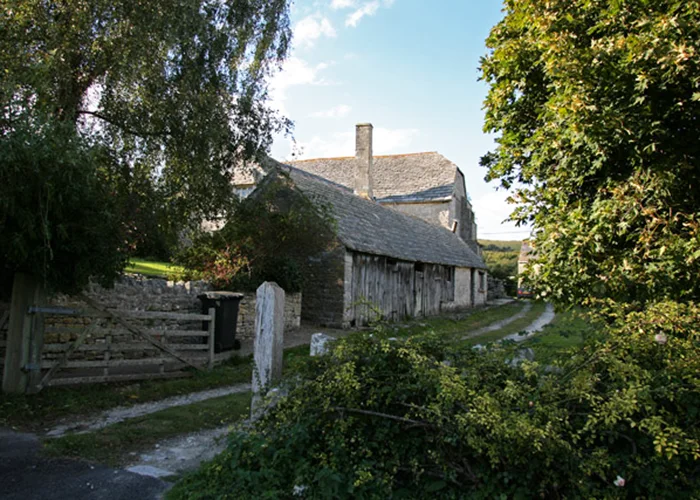
Mike Searle / Barnston Manor / PhotoCC BY-SA 2.0
The churchyard of St Peter's holds an unlikely industrial connection: the graves of the Pike brothers, John William Pike and William Joseph Pike, who were the dominant force in the Purbeck ball clay industry in the Victorian era, and who in 1866 brought the first steam locomotive to the Isle of Purbeck. They named it Primus.
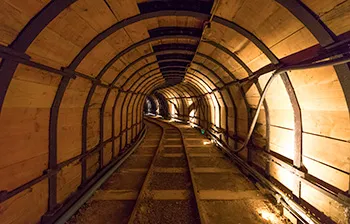
The Pike family's involvement in Purbeck clay dates to the 18th century, when Joseph Pike established the business and his son William signed a contract with Josiah Wedgwood in 1791 to supply clay for his famous pottery. By the 19th century, the Pike Brothers firm at Furzebrook was one of Purbeck's two great clay dynasties (the other being Fayles at Norden). Ball clay, a smooth, highly plastic clay used in fine ceramics, was extracted from open-cast and later underground workings across north Purbeck, carried by narrow-gauge railway to wharves on the River Frome, and shipped out to potteries across Britain and beyond.
Also buried in the churchyard is a third brother, Warburton Pike, a man of very different inclinations. Rather than clay and locomotives, Warburton was a traveller and literary translator, and in 1881 he produced the first English translation of Dante's Inferno. The Pike family home, Bucknowle House, stands to the north-west of the village.
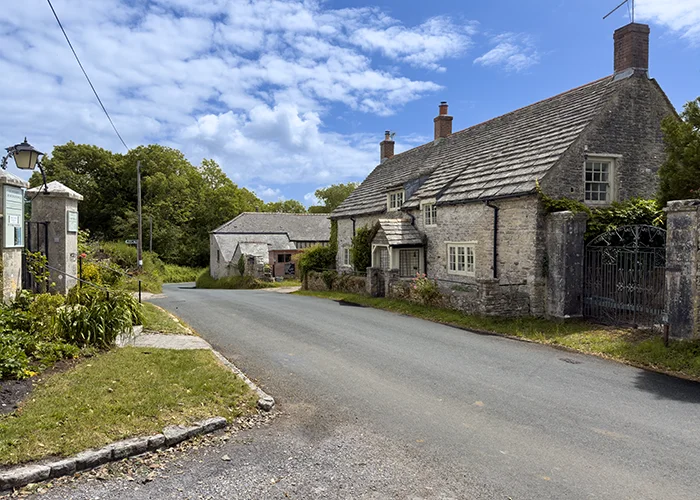
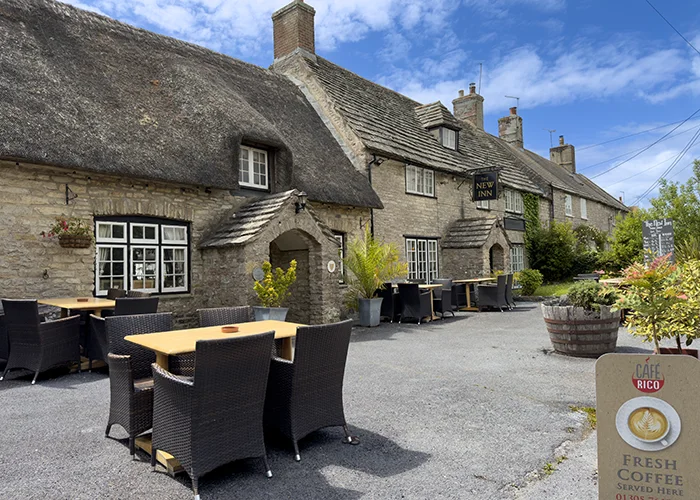
The village pub's name is, as Dorset Life drily observed, "somewhat misleading." The New Inn at Church Knowle is a 16th-century stone and thatched inn, in one 150-year period it had just four landlords, and today it offers hearty food, real ales, and a cosy garden ideal for walkers and dog owners. It sits directly beneath the Purbeck ridge, within easy reach of footpaths to Corfe Castle, the Blue Pool, Kimmeridge, and the Tyneham valley.
The village has no shops, the nearest are in Corfe Castle or Wareham, but the pace of life at Church Knowle retains the character of a genuinely working Dorset community. The annual village fête takes place in August in the grounds of the Old Rectory (the rectory itself is no longer a church property). An decommissioned postbox, painted black in the former Post Office facade, is a characteristic and much-photographed village detail.
Church Knowle is also home to the Margaret Green Animal Rescue Centre, a well-regarded animal welfare charity with a site open to visitors (10am–4pm). The centre cares for cats, horses, farm animals, rabbits, guinea pigs, and birds, and makes for a popular family stop.
Everything you need for a visit to Church Knowle.
From Wareham, take the A351 towards Corfe Castle; turn right just before the castle on the lane signposted for Church Knowle. From Corfe Castle, it is under a mile west via minor roads. Postcode: BH20 5NQ.
The New Inn (BH20 5NQ) is the village's only refreshment stop, a 16th-century thatched pub serving food year-round. There are no shops; the nearest are in Corfe Castle village.
The Margaret Green Animal Rescue Centre in the village is open 10am–4pm. It cares for a wide range of animals and welcomes visitors. Tel: 01929 480474.
Footpaths from the village lead to Corfe Castle (1.2 miles), the Blue Pool (1 mile), and the Purbeck ridge. The area is criss-crossed with bridleways suitable for cyclists and horse riders.
OS Explorer OL15 (Purbeck & South Dorset) covers Church Knowle and all surrounding walks. Grid reference for the church: SY940819.