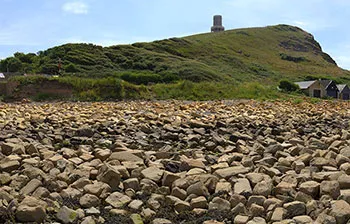
Getting There
From Corfe Castle, take the B3069 south for two miles. Two free car parks are provided by the Encombe Estate: Houns Tout (BH20 5LL) and Sheep Pens (BH20 5LP), both a short walk from the village.

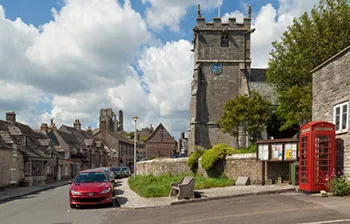
Perched on the southern ridge of the Purbeck Hills, Kingston is an estate village of handsome Purbeck stone, home to a Victorian church grand enough to earn the nickname "Cathedral of the Purbecks," a pub garden with one of the finest views in Dorset, and walks leading to the highest point of the entire peninsula.
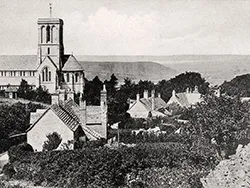
Kingston sits roughly two miles south of Corfe Castle at the top of the southern Purbeck ridge, looking out over sweeping downland and the shimmering course of the Swanage Railway far below.
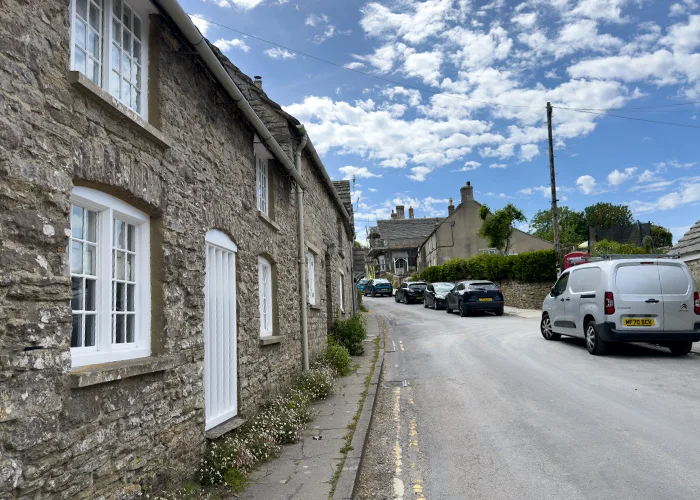
Almost every building here is constructed from local Purbeck limestone, giving the village a geological coherence you notice the moment you arrive. Clustered around a modest crossroads on West Street, the village is small, a church, a pub, a scattering of stone cottages, yet it punches well above its weight historically and scenically. The Encombe Estate, which owns around 2,000 acres of the surrounding countryside and stretches south to the Jurassic Coast, has shaped Kingston's character for nearly three centuries.
Getting there is straightforward: from Corfe Castle take the B3069 south for about two miles. There are two free car parks provided by the Encombe Estate, Houns Tout Car Park (BH20 5LL) and Sheep Pens Car Park (BH20 5LP), both a short walk from the village centre.
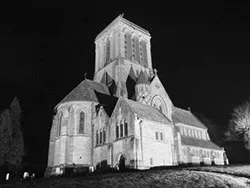
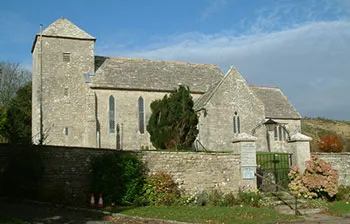
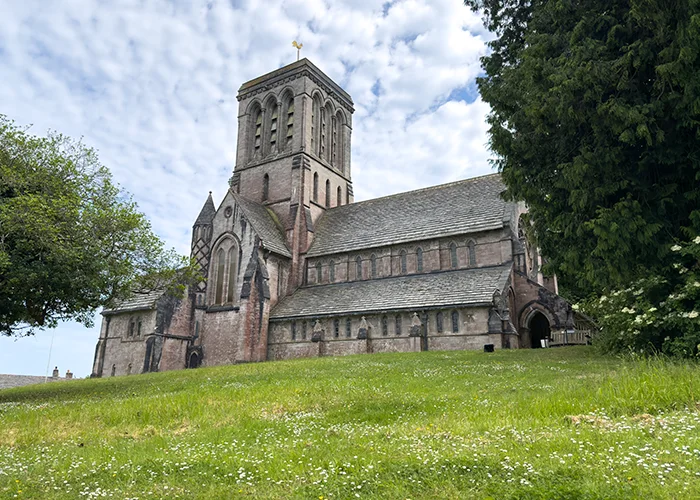
St James's Church is Kingston's most extraordinary landmark, a Gothic Revival masterpiece designed by the eminent Victorian architect George Edmund Street, built between 1874 and 1880 at a reported cost of £70,000 (equivalent to over £4 million today). It was commissioned by the 3rd Earl of Eldon, who wanted a church befitting his Encombe Estate, and Street delivered something altogether more ambitious than the village's size might suggest.
The result is a Grade I listed building of considerable drama: an apsidal chancel, nave, transepts, and a lofty central tower housing ten bells. Inside, a stone-groined chancel roof, a screen and pulpit of Purbeck marble, and a large rose window at the west end combine to create an interior of cathedral-like solemnity. Architectural historians have traced influences from Norman Normandy (the tower echoes the church at Norrey-en-Bassin), Early English Gothic, and the work of Street's contemporaries. Pevsner noted that the north transept stair turret replicates one at Christchurch Priory.
The church stands on the site of a much earlier 13th-century chapel, which served Kingston as a chapel-of-ease for Corfe Castle parish for seven centuries. That older building, now a private residence, still stands in the east of the village. The new church was consecrated in 1921 and became the parish church in January 1922.
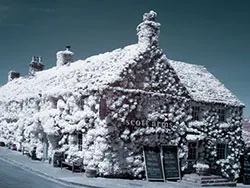
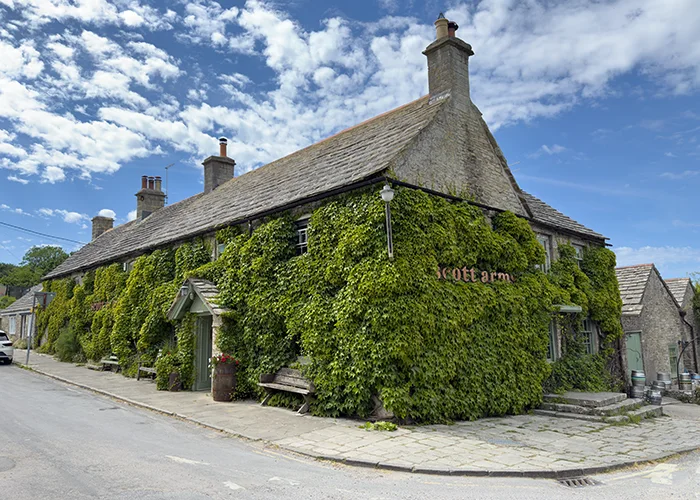
Kingston's pub has been drawing visitors since 1787, when it opened as the New Inn before being renamed the Eldon Arms after the estate's proprietors. Today it trades as the Scott Arms, taking the name from John Scott, 1st Earl of Eldon, and its rear garden is widely regarded as offering one of the finest pub views in Dorset. From the terraced lawn, Corfe Castle sits directly in your eyeline, with the Swanage Railway threading the valley below and the Purbeck Hills rolling away to the north.
The building itself is a Grade II listed late-18th/early-19th-century rubble stone construction, covered through much of the year in Virginia creeper. Inside, three open fires warm the bar through winter; in summer, the Jerk Shak outdoor kitchen serves Caribbean food in the garden. Four en-suite B&B rooms round out the offering.
Local ales, including beers from Purbeck-area breweries, feature alongside ciders from local producer Purbeck Cider. The pub is dog-friendly and serves locally sourced food throughout the year. Postcode for sat-navs: BH20 5LH.
Kingston cannot be understood without knowing something of Encombe, the private country estate that still owns approximately 2,000 acres of the surrounding land. Encombe House, a Grade II* listed mansion of Purbeck stone built around 1735, set in Grade II* registered parkland, lies a mile to the south-west and is not open to the public. But its influence on Kingston is visible everywhere, from the uniform Purbeck stone of the estate cottages to the grand scale of St James's Church itself.
The estate was purchased in 1734 by George Pitt, whose son John built the present house. It passed to William Morton Pitt, a noted philanthropist who established twine and sail-making employment in Kingston. Most significantly, the estate was later acquired by John Scott, 1st Earl of Eldon, Lord Chancellor under both Pitt the Younger and Lord Liverpool, whose family commissioned the new church, rebuilt village properties, and employed Humphry Repton to improve the grounds. The 1st Earl was famously buried in the church he commissioned.
A family legend, for which no firm evidence exists, holds that a romantic scandal between the 1st Earl and the vicar's wife explains why Kingston came to have two churches in such a small village. History is discreet on the matter.
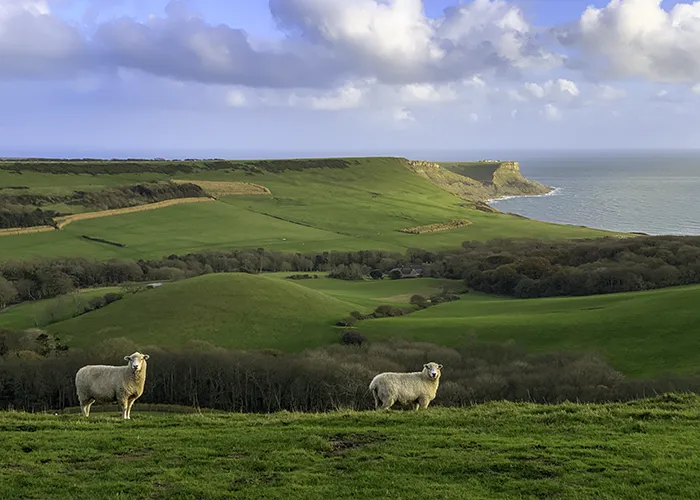
Kingston is the ideal base for one of the most rewarding short walks in Purbeck. Swyre Head, at 208 metres (682 feet) the highest point of the Purbeck Hills, lies barely a mile from the village, reached on foot across Encombe Estate farmland. On a clear day the summit commands views from the Isle of Portland and Weymouth Bay in the west, across Kimmeridge, the Clavell Tower, and the Jurassic Coast, to Poole Harbour and the Isle of Wight in the east. On the finest days, Dartmoor is visible on the far horizon.
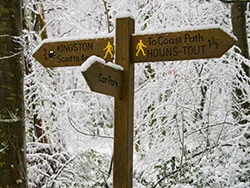
From Swyre Head the ridge continues east to Houns-tout cliff, perched above the secluded cove of Chapman's Pool. A longer circular route descends to Kimmeridge Bay, returning on the South West Coast Path, a six-mile circuit taking around two hours. The Purbeck Breezer 40 bus connects Kingston with Corfe Castle, Wareham, Swanage, and Poole, making linear walks straightforward.
Kingston itself lies within the Dorset National Landscape (formerly AONB), and the surrounding network of public footpaths and bridleways gives walkers and cyclists access to some of the most unspoilt downland in southern England.
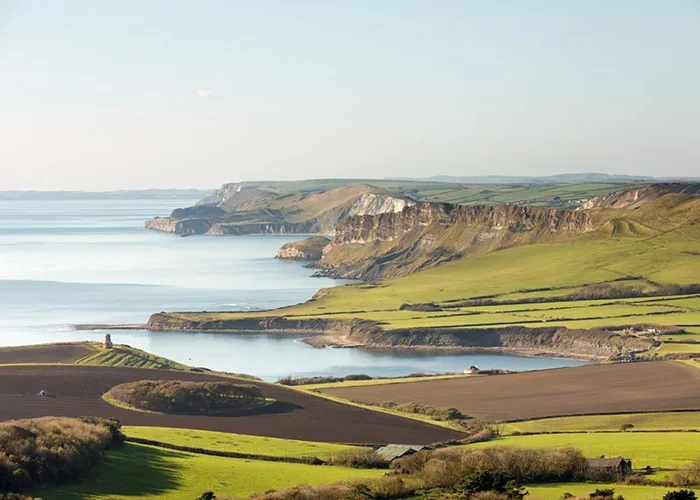
Everything you need to plan your visit to Kingston.
From Corfe Castle, take the B3069 south for two miles. Two free car parks are provided by the Encombe Estate: Houns Tout (BH20 5LL) and Sheep Pens (BH20 5LP), both a short walk from the village.
The Purbeck Breezer 40 service links Kingston with Swanage, Corfe Castle, Wareham, and Poole. Check current timetables on the Morebus website.
The Scott Arms (West Street, BH20 5LH) offers food all year, local ales, cider, and four en-suite B&B rooms.
St James's Church is typically open during daylight hours. The interior, Purbeck marble screen, rose window, carved ironwork, is well worth the visit. No charge for entry.
The Scott Arms is dog-friendly. The estate footpaths are accessible with dogs on leads, though livestock grazes across the ridge walks, keep dogs under close control near fields.
OS Explorer OL15 (Purbeck & South Dorset) covers Kingston, Swyre Head, and the coast paths. Grid reference for the village: SY957796.