Burngate Stone Centre
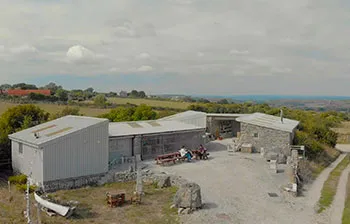
A working Purbeck stone carving centre just 0.4 miles away, learn about the same stone in which the footprints are preserved.
Visit Burngate

Walk in the footsteps, literally, of creatures that roamed Purbeck 145 million years ago. A remarkable fossil trackway discovered in 1997 during active quarrying, now open to visitors.
At Spyway, near Langton Matravers, an ancient mudflat has been preserved in rock for 145 million years, complete with the footprints of the dinosaurs that walked across it.
The Spyway Dinosaur Footprints are one of the most unusual and accessible fossil sites on the entire Jurassic Coast. Unlike the ammonites and ichthyosaurs that erode from the cliffs at Charmouth or Kimmeridge, these are trace fossils, direct evidence not of an animal's body but of its behaviour. At this site, in a working Purbeck limestone quarry not far from the village of Langton Matravers, a slab of ancient mudstone preserves the footprints of several different species of dinosaur that walked across a muddy shore at the very end of the Jurassic period, approximately 145 million years ago.
The Purbeck Group rocks that contain the footprints were deposited in a shallow tropical lagoon environment, warm, flat, and seasonally drying, something like the Florida Everglades or the tidal flats of the Persian Gulf, but in a world without grass, without flowering plants, and where the dominant animals were reptiles. This was the world the dinosaurs walked through, and their feet left impressions in the soft sediment that hardened and mineralised before being buried under further deposits, preserving them until quarrymen exposed them in 1997.
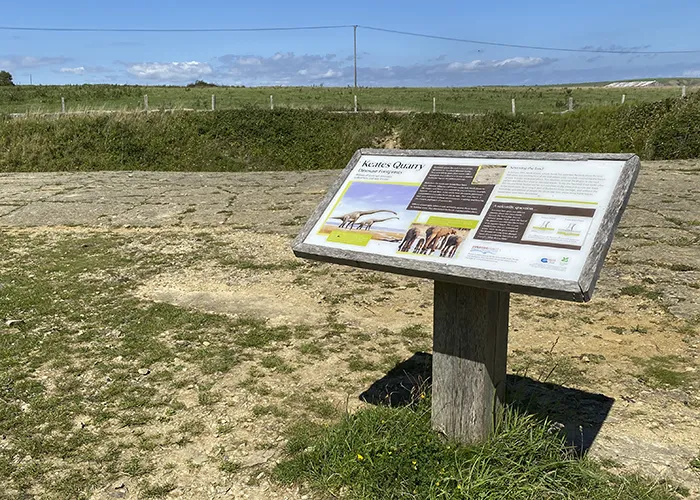
The trackway was discovered in 1997 by quarrymen Kevin Keates and Trev Haysom while the stone quarry at Spyway was still being actively worked to extract Purbeck building stone. As the quarrymen cleared and split the stone, they exposed the remarkable surface of tracks that had lain undisturbed beneath the fields for 145 million years. The discovery was immediately recognised as scientifically significant, and the site has been protected and managed for public access ever since.
The discovery is a reminder of how closely the stone quarrying tradition of Purbeck and the area's remarkable geology are intertwined. The same quarrying activity that has been revealing the bones of Purbeck's geological past for centuries, used stone from the same series of rocks in the cathedrals of medieval England, also brought this prehistoric trackway to light. Without the working quarry, these footprints would still be hidden beneath metres of rock.
The tracks provide direct evidence of the size, gait and in some cases the speed of movement of dinosaurs that walked here at the boundary of the Jurassic and Cretaceous periods. The diversity of tracks suggests that this area was a dynamic environment where several different types of dinosaurs co-existed along the margins of a shallow lagoon.
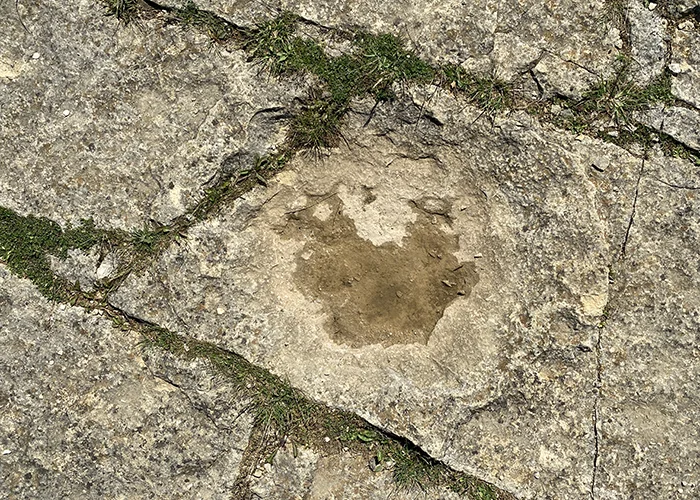
The Spyway footprints are preserved in the Purbeck Group, a sequence of limestones and mudstones deposited during the Late Jurassic to Early Cretaceous periods, roughly 145 to 130 million years ago. At the time these sediments were laid down, what is now southern England lay much further south, at a latitude similar to present-day Morocco, in a warm, shallow tropical environment.
The specific layer that contains the footprints represents a moment when the muddy shore of a lagoon was exposed, either seasonally drying or briefly above water, allowing dinosaurs to walk across it and leave impressions. The soft sediment was rapidly buried by the next sediment layer, and over millions of years both layers were compressed into rock and mineralised, preserving the footprints in extraordinary detail.
The types of footprint found at Spyway include tracks from large theropods (meat-eating dinosaurs that walked on two legs, like large relatives of the animals that would eventually give rise to birds), smaller ornithopods (bipedal plant-eaters), and possible sauropods (the long-necked plant-eating giants). The diversity of tracks suggests a rich and varied dinosaur fauna living along the margins of the Purbeck lagoon system. These rocks are part of the same Jurassic Coast that earned UNESCO World Heritage Site designation in 2001, the first natural World Heritage Site in England.
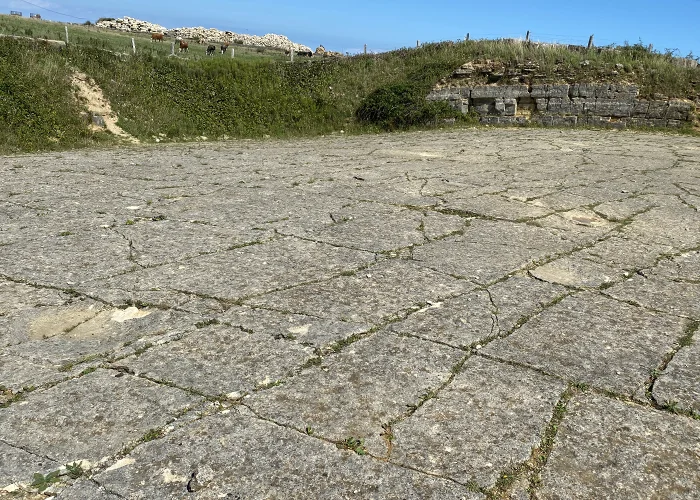
The footprints are preserved in the same stone that built the medieval cathedrals of England, Purbeck limestone, quarried in this valley for over 2,000 years. A remarkable coincidence of natural and human history.
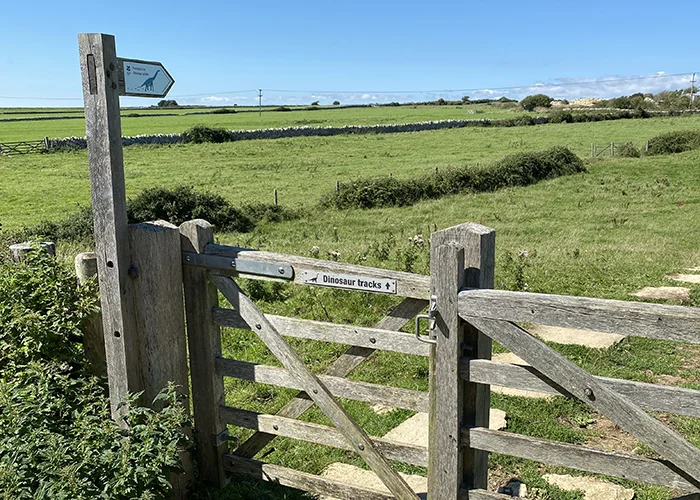
The footprints are free to visit, but there is a short walk across fields to reach them. The site has interpretation boards but no facilities.
A working Purbeck stone carving centre just 0.4 miles away, learn about the same stone in which the footprints are preserved.
Visit Burngate

The charming stone village 1 mile from the footprints, with a pub, tea room and the Langton Matravers Museum.
Explore Langton
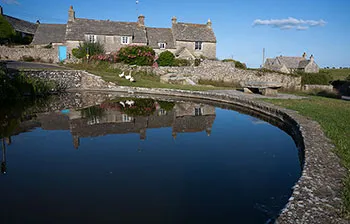
Continue along the Priest's Way to the classic Purbeck stone village of Worth Matravers and the coast at Chapman's Pool or Winspit.
Explore Worth Matravers
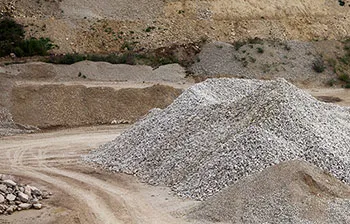
The footprints were found during active quarrying, a reminder that the stone industry and geology of Purbeck are inseparable.
About quarrying

The Spyway footprints are part of the Jurassic Coast UNESCO World Heritage Site, find out more about the geology of the whole coast.
Jurassic Coast Trust
The ancient bridleway between Swanage and Worth Matravers passes the dinosaur footprints site — an excellent circular day walk.
Walking routes
Sources used to verify and expand the content on this page: