Old Harry Rocks
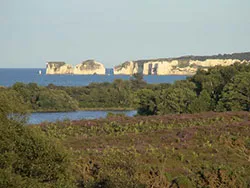
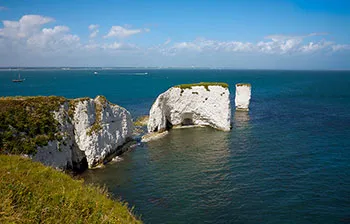
The dazzling white chalk sea stacks at the southern end of the bay, an easy walk from the village.
Visit Old Harry

Four miles of golden sand, a rare wildlife-rich heath, a Norman church and a quiet D-Day secret in one of the most beautiful and unspoilt corners of the Dorset coast.
At the north-eastern tip of the Isle of Purbeck, about five miles from Swanage, Studland is a small village wrapped in some of the finest natural scenery in southern England.
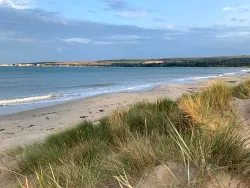
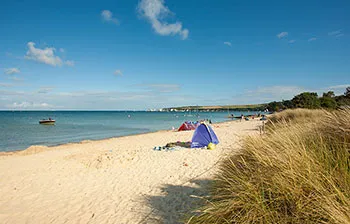
Studland Bay sweeps in a four-mile arc of soft golden sand from the chalk headland of Old Harry Rocks in the south to the mouth of Poole Harbour in the north. Behind the beach lies a wild expanse of sand dunes, freshwater lagoon, woodland and rare lowland heath, while the village itself, a scatter of cottages, houses, a famous old pub and a remarkable Norman church, sits quietly between the two.
Sheltered from the prevailing winds by Ballard Down and Handfast Point, the bay has gentle, shallow, clear water that makes it a favourite for families, swimmers and watersports alike. But Studland is far more than a beach: it is one of the most important wildlife sites in the country, a place of deep history, and the quiet stage for one of the most significant rehearsals of the Second World War.
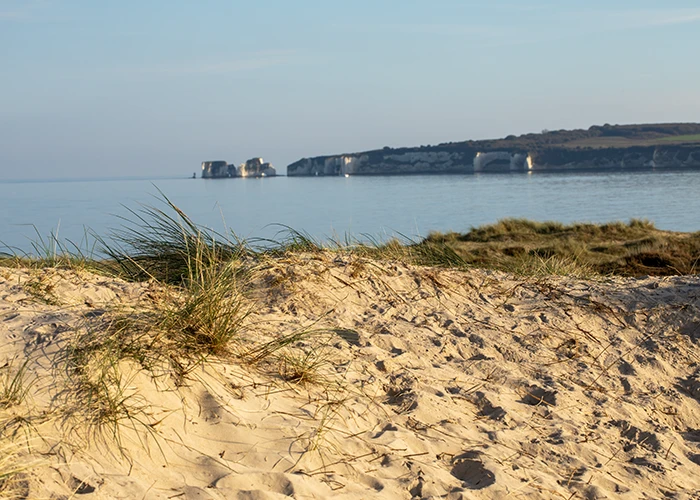
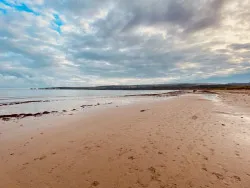
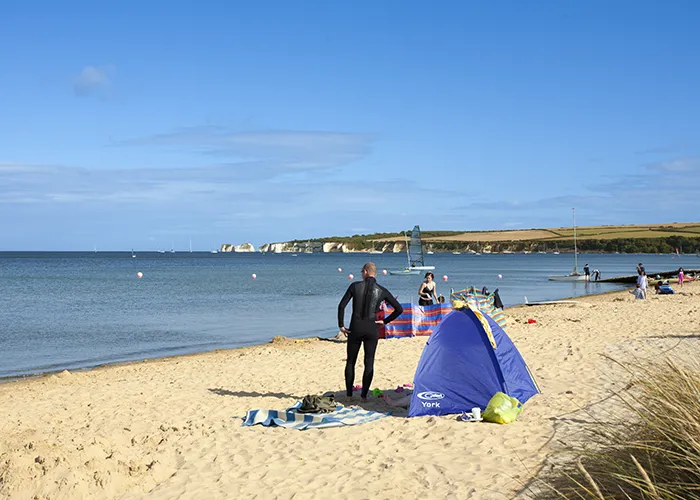
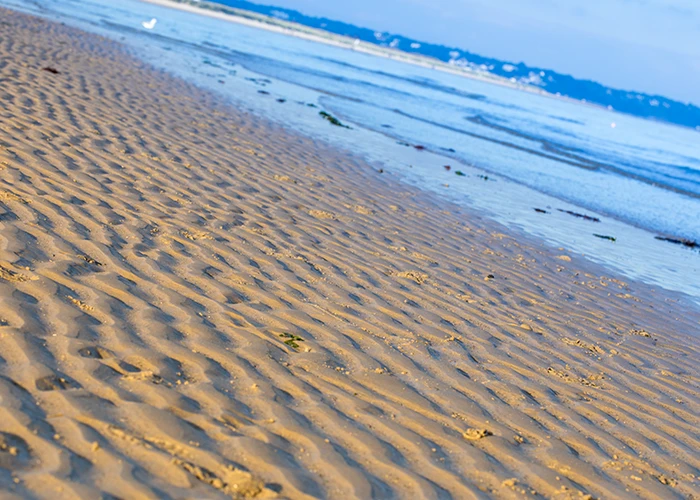
Studland's beach is regularly rated among the very best in Britain. Four miles of clean, soft sand curve gently round the bay, backed by dunes and low sandstone cliffs, with shallow, sheltered water that is ideal for swimming and paddling. It runs in a series of named stretches, South Beach, Middle Beach, Knoll Beach and, at the northern end, Shell Bay, each with its own character, and all giving wonderful views across to Old Harry Rocks and out to the Isle of Wight.
The calm bay is a natural playground for watersports: you can swim, sail, windsurf, snorkel, paddleboard or hire a canoe, and there are beachside cafés, a visitor centre, toilets and a first-aid post. Dogs are welcome year-round (on a short lead on the beach from May to September). One stretch of beach, towards the northern end, has been Britain's best-known naturist beach since the 1920s, clearly signed and set apart from the family areas.
A word of caution: while the bay itself is gentle, the water near the northern end by the Sandbanks ferry mouth has strong tidal currents and should be avoided by swimmers.
Behind the beach lies Studland and Godlingston Heath, a National Nature Reserve and one of the largest tracts of lowland heath in southern Britain. It is a rich mosaic of dune heath, bog, woodland, the freshwater lagoon known as Little Sea, and Poole Harbour's saltmarsh, and it forms part of the Purbeck Heaths "super" National Nature Reserve, one of the most ambitious conservation landscapes in the country.
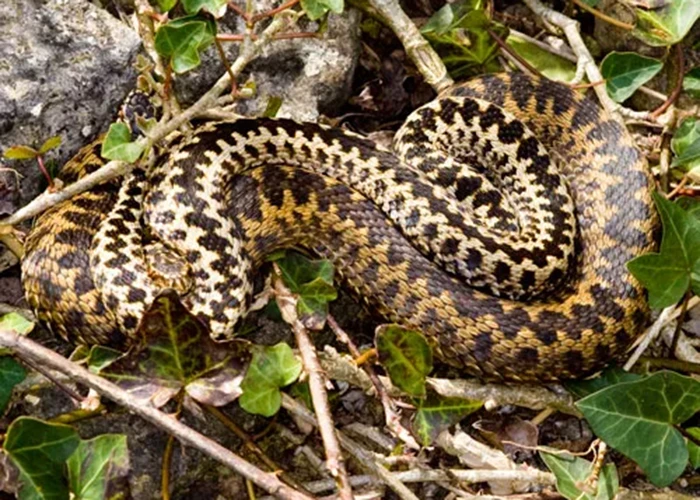
The wildlife here is exceptional. Studland is one of the very few places in Britain where you can find all six native British reptiles, the common lizard, the rare sand lizard, the slow worm, the grass snake, the adder and the nationally rare smooth snake. It is a stronghold of the elusive Dartford warbler, which clung on here through hard winters that wiped it out elsewhere, and is home to nightjars, around twenty species of dragonfly and damselfly, rare butterflies and even insect-eating sundew plants. Offshore, the seagrass beds of Studland Bay are a nationally important nursery for both British species of seahorse, the spiny and the short-snouted.
A network of waymarked trails and boardwalks threads through the reserve from the beach car parks, with hides for birdwatching over Little Sea.
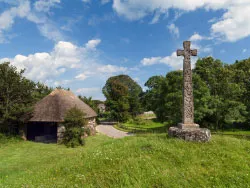
At the eastern end of the village stands the church of St Nicholas, one of the best-preserved Norman churches in England, and quite possibly the oldest church in Dorset. The present building dates from around 1180 and looks much as it did when it was raised, with a squat central tower, sturdy round arches and a wealth of carved corbels, gargoyles and grotesques. It stands on the site of an earlier Saxon church from the very beginnings of Christianity in the area, and in the churchyard a Celtic-style cross, erected in 1976, reuses the base of an ancient Saxon cross.
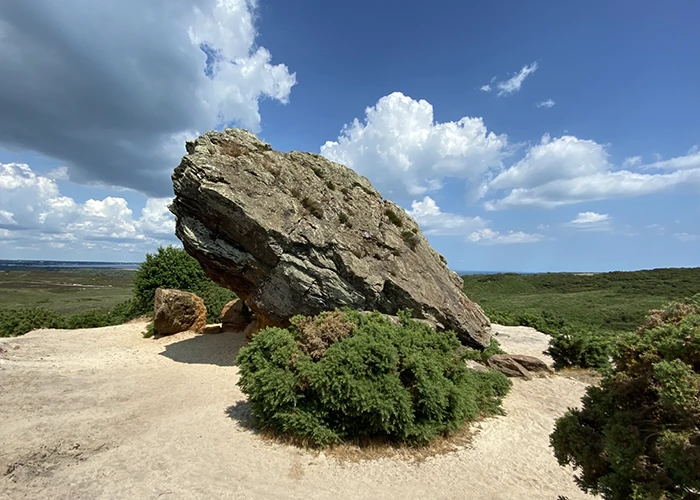
Out on the heath to the west looms one of Purbeck's strangest landmarks: the Agglestone Rock, a great natural block of ironstone weighing many tons, perched on a heather-clad mound. Folklore says the Devil hurled it from the Isle of Wight, intending to strike Corfe Castle (or Salisbury Cathedral) but falling short. Once shaped rather like an anvil or upturned table, the stone toppled in 1970, but it remains a magnet for walkers and a fine spot for views across the heath and bay.
Studland's storybook charm has literary connections, too, the village is said to have inspired "Toytown" in Enid Blyton's Noddy stories.
Studland's gently shelving beach bore an uncanny resemblance to the beaches of Normandy, and in the Second World War it became a crucial training ground for the D-Day landings. The whole area was used for live-firing rehearsals, and traces of that time still litter the dunes, concrete "Dragon's Teeth" anti-tank blocks between Middle Beach and Fort Henry, and bunkers across the heath.
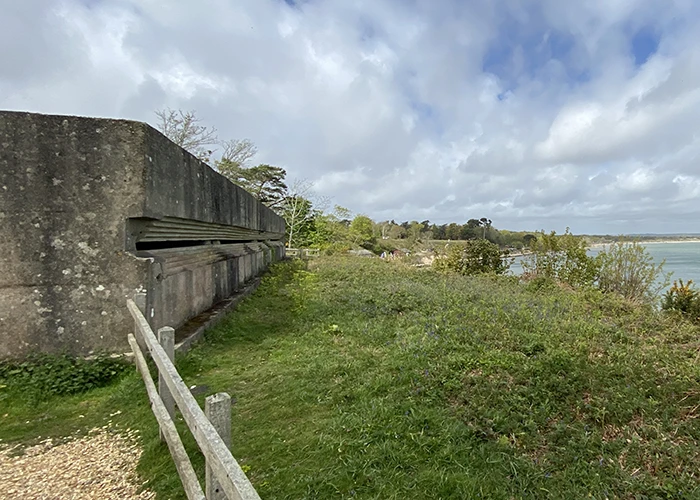
Above Middle Beach, on Redend Point, stands Fort Henry: a long, low concrete observation bunker built in 1943 by Canadian engineers, with walls three feet thick and a wide observation slit looking out over the bay. From here, on 18 April 1944, an extraordinary gathering watched the great live-ammunition rehearsal known as Exercise Smash, among them King George VI, Prime Minister Winston Churchill, and the Allied commanders General Eisenhower and General Montgomery.
The rehearsals used amphibious "Duplex Drive" floating tanks, and not without cost: several tanks sank and men were drowned during the trials. A memorial near the bunker remembers them. You can still walk up to Fort Henry today and look out over the bay exactly as those wartime leaders did. (If you ever find old ammunition on the beach, never touch it, report it to a National Trust ranger.)
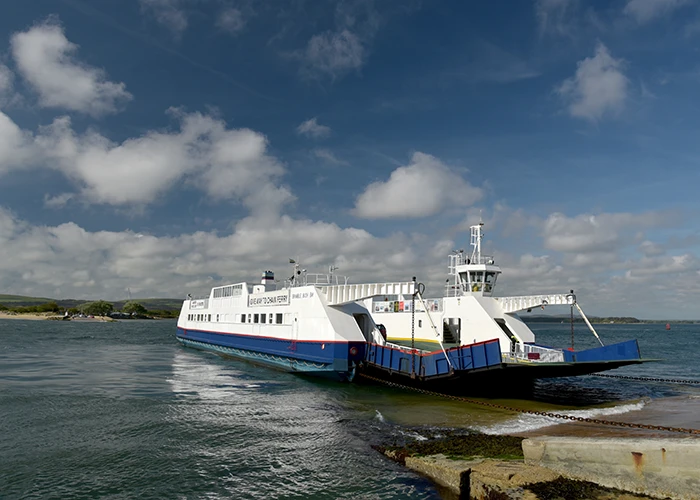
Studland is wonderfully easy to reach without a long drive. From the north, the Sandbanks Chain Ferry carries cars and foot passengers across the narrow mouth of Poole Harbour from Sandbanks, a short and scenic crossing that drops you right beside Shell Bay. From the rest of Purbeck, the B3351 runs across the heath from Corfe Castle, while the seasonal No.50 Purbeck Breezer bus links Swanage and Bournemouth via the ferry, an ideal car-free option on busy days.
The National Trust runs three main beach car parks at South Beach, Middle Beach and Knoll Beach (free for members), each with footpaths onto the sand and into the dunes. Knoll Beach is the main hub, with the visitor centre, café and shop. From any of them you can set out on foot: south along the coast path to Old Harry Rocks and Ballard Down, west across the heath to the Agglestone, or north along the sands to Shell Bay.
Studland makes a superb day out and an equally good base, quiet, beautiful, and surrounded by some of the best walking and wildlife in Dorset.
Knoll Beach is the main hub, with the café, shop and easiest access. Middle and South Beach are quieter and closer to the village and Old Harry. Shell Bay, by the ferry, has the wildest, emptiest sand, and the best harbour views.
What to see in and near the village, and where to head next around the bay and beyond.
The dazzling white chalk sea stacks at the southern end of the bay, an easy walk from the village.
Visit Old Harry
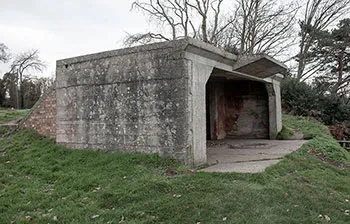
The WWII observation bunker above Middle Beach, with views over the bay and a D-Day memorial.
The D-Day story
A vast natural ironstone block on the heath, wrapped in Devil legends, with sweeping views.
Walk the heath
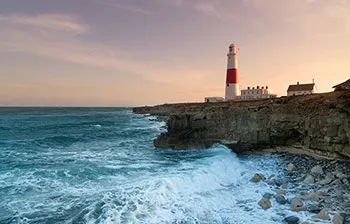
Studland marks the very start of England's only natural World Heritage Site.
About the coast
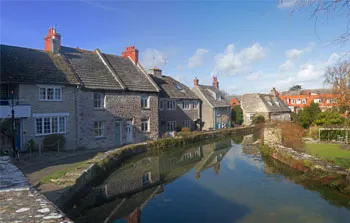
The lively Victorian seaside town just south over Ballard Down, with its pier and steam railway.
Discover Swanage
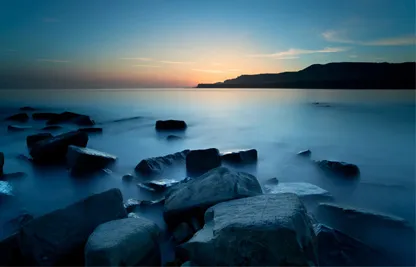
The wider landscape of heaths, hills and coast that Studland opens onto.
Explore Purbeck
Sources used for the history, wildlife and visitor information added to this page: