Jurassic Coast
Ninety-five miles of cliffs, coves and beaches stretching from Old Harry Rocks to Exmouth, 185 million years of Earth's history written in stone, and the finest fossil-hunting coastline in the world.
The Coast
185 million years of Earth's history
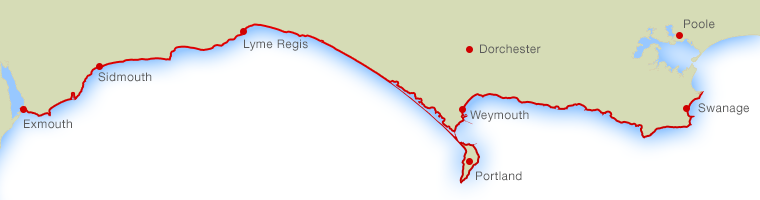
The Jurassic Coast is England's first natural World Heritage Site, a 95-mile stretch of the south coast of England where you can read the entire story of the Triassic, Jurassic and Cretaceous periods in a single walk along the shore.
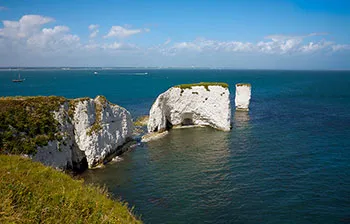
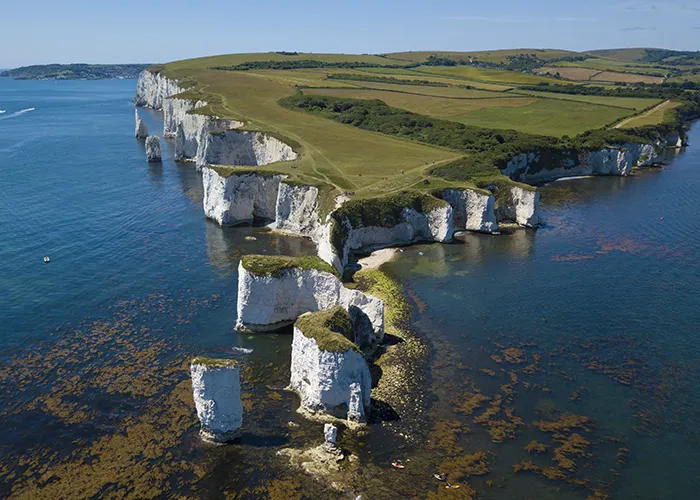
The coast runs from the chalk headland of Old Harry Rocks at Studland in the east to the red Triassic sandstone cliffs of Orcombe Point near Exmouth in the west, crossing from Dorset into Devon. What makes it extraordinary is not just what you can find along it, but that the rocks grow progressively older as you walk west, so a journey from Studland to Exmouth is quite literally a journey back in time through 185 million years of the planet's past.
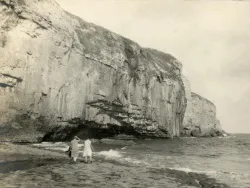
Designated a UNESCO World Heritage Site in 2001, the first in England on purely natural grounds, the Jurassic Coast is home to some of the richest fossil beds in the world, dinosaur footprints, extraordinary geological formations, rare habitats and dramatic scenery. For visitors to Swanage and the Isle of Purbeck, the eastern end of the coast is right on the doorstep: Old Harry Rocks, Swanage Bay, Dancing Ledge, Kimmeridge, Chapman's Pool and Durdle Door are all part of this living geological record.
Three periods, one coastline
A walk through deep time
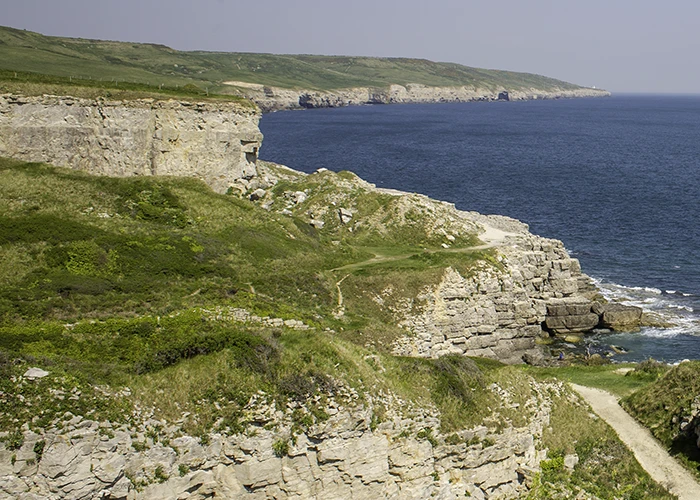
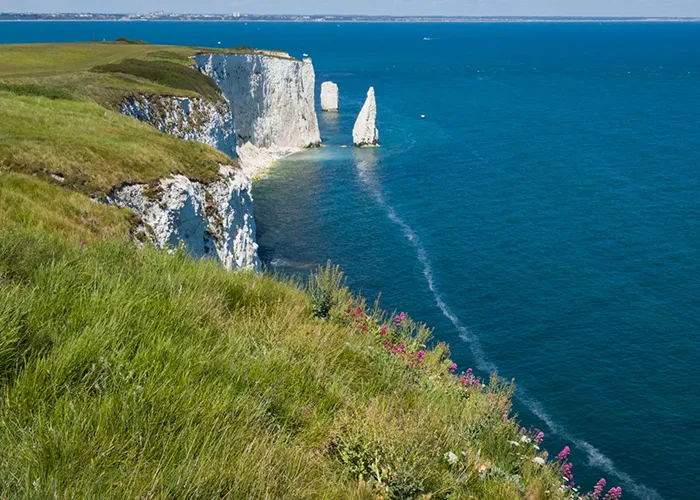
The Jurassic Coast is the only place on Earth where rocks from the Triassic, Jurassic and Cretaceous periods are exposed in an unbroken sequence along a single stretch of coastline. At the western end, the brick-red cliffs of Orcombe Point and Ladram Bay belong to the Triassic, a hot, arid world of desert and shallow seas, 252 to 201 million years ago. Continuing east, the cliffs shift through the dark Jurassic limestones and shales, rich in ammonites and marine reptiles, before reaching the brilliant white chalk of the Cretaceous, laid down in warm tropical seas and ending at the great chalk stacks of Old Harry Rocks near Studland.
This geological cross-section is so clear and so complete that scientists have used it for two centuries to piece together the history of life on Earth. Erosion constantly exposes new fossils along the shore, making every visit potentially a moment of discovery. The cliffs retreat at different rates, some rapidly enough that fresh fossil layers are revealed after every storm.
For visitors staying in Swanage, the Cretaceous chalk scenery of Old Harry Rocks and Ballard Down marks the very eastern tip of this extraordinary record, while the Jurassic Portland limestone, quarried for centuries to build St Paul's Cathedral and Buckingham Palace, lies just along the coast to the west.
The fossil coast
Ammonites, ichthyosaurs & Mary Anning
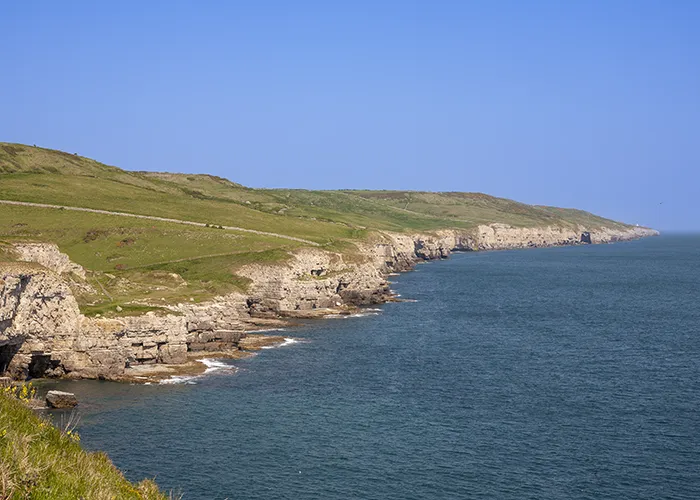
The Jurassic Coast is among the most productive fossil sites in the world. Ammonites, the coiled, chambered shells of ancient marine molluscs, are found all along the shore, from palm-sized specimens to giants more than a metre across. At Kimmeridge, just along the coast from Swanage, the dark Kimmeridgian shale ledges regularly yield ammonites, fish teeth and the bones of marine reptiles. At Charmouth and Lyme Regis further west, ichthyosaurs, the dolphin-like "fish lizards" that ruled the Jurassic seas, emerge from the cliffs after heavy rain.
It was at Lyme Regis that Mary Anning, the self-taught daughter of a local cabinet maker, made some of the most important fossil discoveries of the nineteenth century. Working the foreshore from childhood in the 1810s, she found the first complete ichthyosaur skeleton, the first British plesiosaur, and a pterosaur. Her work helped to reshape the scientific understanding of prehistoric life and the age of the Earth, at a time when women were excluded from scientific institutions. The Lyme Regis Museum, now housed in a building on the site of her birthplace, celebrates her life and discoveries.
Fossil hunting is encouraged along the Jurassic Coast, on the beach and foreshore the collecting of loose fossils is generally permitted. The golden rule is to leave the cliffs alone: never dig into them, as they are fragile, dangerous and protected. The best time to look is after winter storms, when fresh material is exposed on the beach.
The eastern gateway
The coast at Purbeck & Swanage
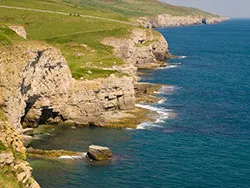
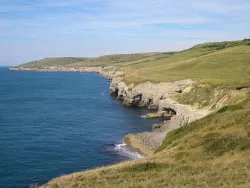
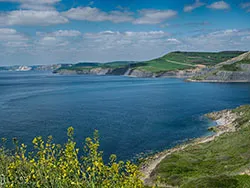
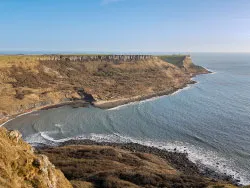
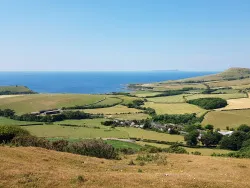
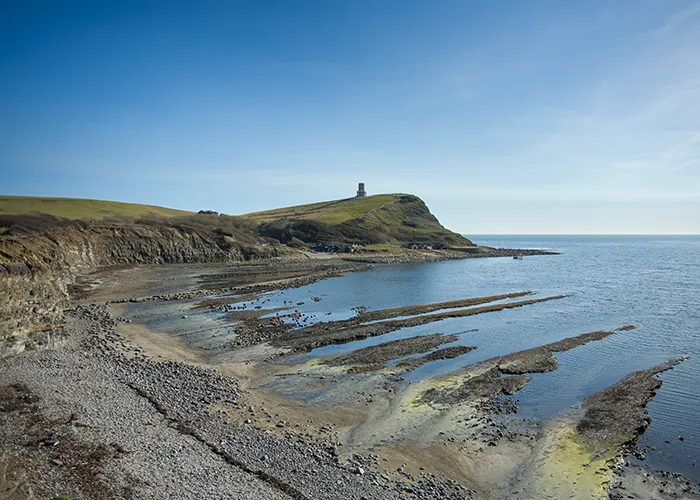
For visitors to Swanage, the Jurassic Coast begins, or ends, right here. The chalk headland of Old Harry Rocks at the northern tip of Studland Bay is the most easterly point of the World Heritage Site, and from here the South West Coast Path runs westwards along one of the most dramatic sections of the entire coast. Ballard Down, Durlston Head, St Aldhelm's Head, Chapman's Pool, Kimmeridge Bay, Lulworth Cove and Durdle Door are all within reach by walking or car in a day.
The Purbeck stretch of the Jurassic Coast is rich in its own geological story. The famous Purbeck Beds, a sequence of limestone, shale and mudstone, were laid down in warm lagoons and shallow seas around 145 million years ago, right at the Jurassic-Cretaceous boundary. They have yielded dinosaur footprints, crocodile teeth and early mammal remains. The beds were quarried for centuries to produce the prized Purbeck marble, a limestone packed with freshwater snail fossils, which lines the interiors of dozens of English cathedrals and churches.
Durlston Country Park on the cliffs south of Swanage has an excellent visitor centre explaining the geology and wildlife of the local coast, while Kimmeridge Bay, managed by the Dorset Wildlife Trust, is one of the best places on the whole coast to explore rock pools and the marine life of the Jurassic sea bed, now exposed as broad limestone ledges at low tide.
Iconic landmarks
Lulworth Cove & Durdle Door
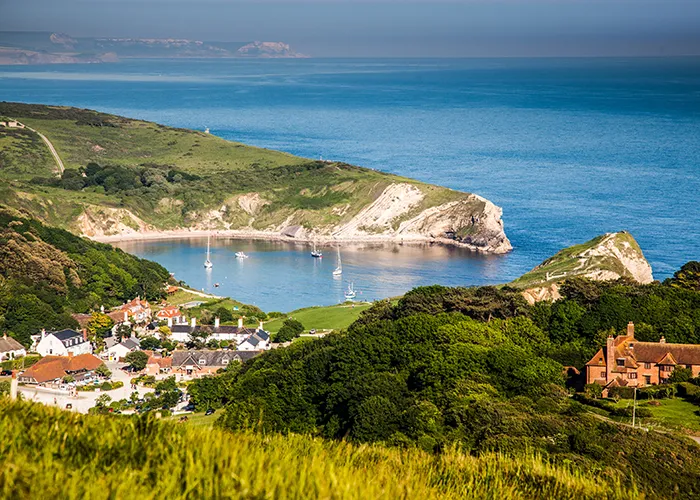
No account of the Jurassic Coast is complete without Lulworth Cove and Durdle Door, its two most celebrated landmarks. Lulworth Cove is a near-perfect circular bay, formed where the sea broke through a band of hard limestone and then scooped out the softer Wealden clays and chalk behind it in a process that took thousands of years. The result is a harbour-like bowl of calm turquoise water, a living geology lesson visited by more than half a million people a year.
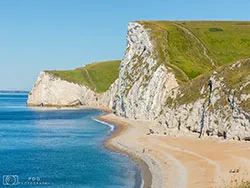
Half a mile to the west, Durdle Door is a natural limestone arch standing in the sea, one of the most photographed views in England. The arch was carved by the relentless action of waves wearing through a headland of hard Portland limestone, the same stone that underlies much of the Jurassic Coast and was quarried to build St Paul's Cathedral. From the clifftop path above, the views east and west along the coast are breathtaking.
Both landmarks are managed by the Lulworth Estate and are reachable on foot from a car park at Lulworth Cove, or by following the South West Coast Path west from Kimmeridge. The area around Lulworth is also used as a military firing range (Lulworth Ranges), and access to the path west of Kimmeridge is restricted on weekdays; check in advance before planning a long walk.
Gateway towns
Places to explore along the coast
The Jurassic Coast Trust designates a series of Gateway Towns, each one a distinct destination in its own right, offering the full range of visitor services while providing access to a particular section of the coast. Swanage and Wareham serve the eastern, Purbeck end of the coast; further west, Weymouth and Portland sit at the heart of the Portland Stone country; and Lyme Regis, Charmouth and Sidmouth give access to the famous fossil cliffs of the Devon-Dorset border.
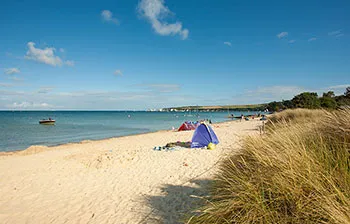
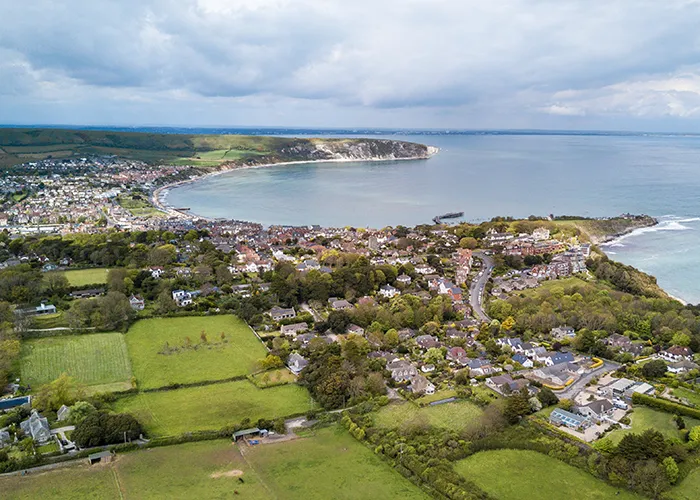
Swanage is particularly well placed as a base. From here you can walk north to Old Harry Rocks, south to Durlston, or take a bus or drive to Kimmeridge, Lulworth or, on a longer day, to Weymouth and Portland. The town itself sits in the heart of the Isle of Purbeck, surrounded by the heaths, hills and coast that make up this remarkable corner of England, and its seafront and beach have attracted visitors since the Victorian era.
Each of the Gateway Towns produces local guides, runs fossil walks and geology events, and is home to at least one visitor centre or museum dedicated to the coast. For a fuller picture of the whole 95-mile site, the Jurassic Coast Trust's own website and visitor centres are the best starting point.
Where to start
Where should I start exploring the Jurassic Coast?
If you're based in Swanage, Old Harry Rocks is the obvious first stop, the chalk stacks are the eastern end of the World Heritage Site and a spectacular walk from Studland. For fossils, head to Kimmeridge or take a day trip to Charmouth. For landmark scenery, Lulworth Cove and Durdle Door are an hour's drive along the coast.
The Jurassic Coast, at a glance
- Designation
- UNESCO World Heritage Site (Natural), inscribed 2001
- Length
- 95 miles (153 km) from Orcombe Point, Exmouth to Old Harry Rocks, Studland
- Age of rocks
- Triassic to Cretaceous, from approximately 252 to 66 million years ago
- Nearest point to Swanage
- Old Harry Rocks, Studland, the eastern tip; accessible on foot from the village
- Gateway towns
- Swanage, Wareham, Weymouth, Portland, Lyme Regis, Charmouth, Sidmouth, Exmouth & more
- More information
- jurassiccoast.org, the Jurassic Coast Trust's official website
Visitor centres & museums along the coast
- Beer Quarry Caves
- Chesil Beach Centre
- Dorset County Museum, Dorchester
- DWT Marine Centre, Kimmeridge
- Durlston Country Park, Swanage
- Fairlynch Museum, Budleigh Salterton
- Lyme Regis Museum (Mary Anning)
- Portland Bill Visitor Centre
- Sidmouth Museum
- Studland Visitor Centre, Knoll Beach
- Swanage Heritage Centre
Tips before you go
- The eastern end of the Jurassic Coast, Old Harry Rocks and the Purbeck cliffs, is right on the doorstep from Swanage; start here and walk west along the South West Coast Path
- Fossil hunting is best after a winter storm, when the sea has freshly exposed the cliff base, look for ammonites on the foreshore at Kimmeridge and Charmouth, not in the cliffs themselves
- Never dig into cliffs or remove rock from the cliff face, it is illegal, dangerous and damages the geological record; only collect loose material from the beach
- The Lulworth Ranges restrict public access to parts of the coast path west of Kimmeridge during the week; check firing times at the range office or online before planning a long walk
- Durlston Country Park just south of Swanage has a good introduction to the local geology and is an excellent first stop before exploring further along the coast
- The Jurassic Coast Trust runs events, guided fossil walks and geology days throughout the year, check jurassiccoast.org for what's on during your visit
References & further reading
Sources and links used for the geology, history and visitor information on this page:
- Jurassic Coast Trust, jurassiccoast.org (official World Heritage Site information, gateway towns, events)
- Wikipedia, Jurassic Coast (geological sequence, designation, extent, fossils)
- Wikipedia, Mary Anning (discoveries at Lyme Regis, ichthyosaur, plesiosaur, scientific impact)
- Lyme Regis Museum (Mary Anning's life and work, guided fossil walks)
- Dorset Wildlife Trust, Kimmeridge Marine Centre (Kimmeridge Bay, rock pools, marine life)
- Lulworth Estate (Lulworth Cove and Durdle Door visitor information)