
Castles and Historic Houses
A ruined royal stronghold, a great Italianate palace, a Tudor fort, a Victorian folly and a clutch of beautiful country manors, Purbeck and its borders are remarkably rich in historic places to visit.
A landscape rich in history
For such a small corner of England, the Isle of Purbeck and its near neighbours have an extraordinary number of fine castles and historic houses, each one a window onto a different chapter of our story.
Purbeck's stone made it both a quarryman's land and a place worth defending. Within a short drive of Swanage you can stand in the dramatic ruins of one of medieval England's mightiest royal castles, walk through a sumptuous Italianate palace filled with Old Master paintings, climb a Tudor coastal fort and explore a Victorian clifftop folly. Beyond those, the wider area holds a 17th-century hunting lodge restored after a great fire, and a scatter of beautiful private manor houses that occasionally open their doors.
Below is a guide to the principal castles and historic houses you can visit (or, in a few cases, admire from outside). Many are looked after by the National Trust or the families that have lived in them for generations, so opening hours vary and a quick check before you set out is always worthwhile.
National Trust
Corfe Castle
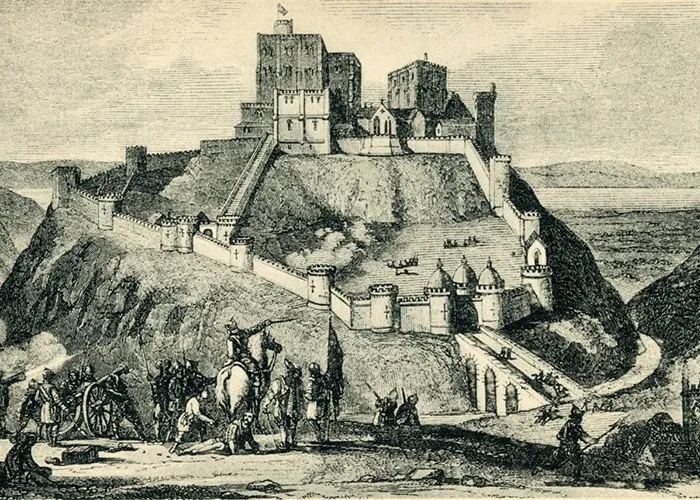
The most famous and dramatic ruin in the area, Corfe Castle rises from a steep natural mound in the one great gap in the chalk ridge of the Purbeck Hills, midway between Wareham and Swanage. The site has been fortified since Saxon times, and it was here, in 978, that the teenage king Edward the Martyr was murdered. The first stone fortifications were raised by William the Conqueror after 1066; the great Norman keep that still crowns the hill was built around 1100 in the reign of Henry I.
For most of the medieval period Corfe was a royal stronghold. King John used it as one of his favourite residences, held part of his treasure here, and as a prison; later, the deposed Edward II was imprisoned here in 1326. In 1572 Elizabeth I sold the castle to her Lord Chancellor Sir Christopher Hatton, and in 1635 it was bought by the lawyer Sir John Bankes. During the Civil War it was famously held against Parliament by "Brave Dame Mary," Lady Bankes, in two long sieges, until a traitor inside its walls let the enemy in. Parliament then ordered it to be "slighted", blown apart with gunpowder so it could never be defended again.
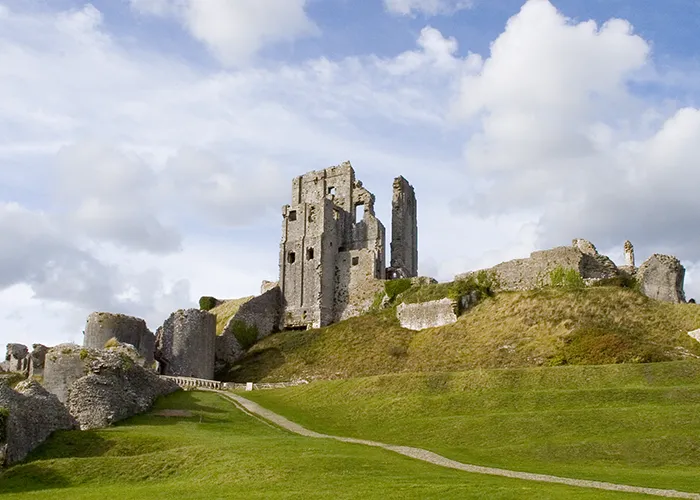
What remains today is one of the most evocative castle ruins in the country, with leaning towers and shattered walls cared for by the National Trust. The castle is free to walk around the foot of, with a visitor centre, shop and tea room in the village; full access to the ruins is ticketed (free to NT members).
National Trust
Kingston Lacy
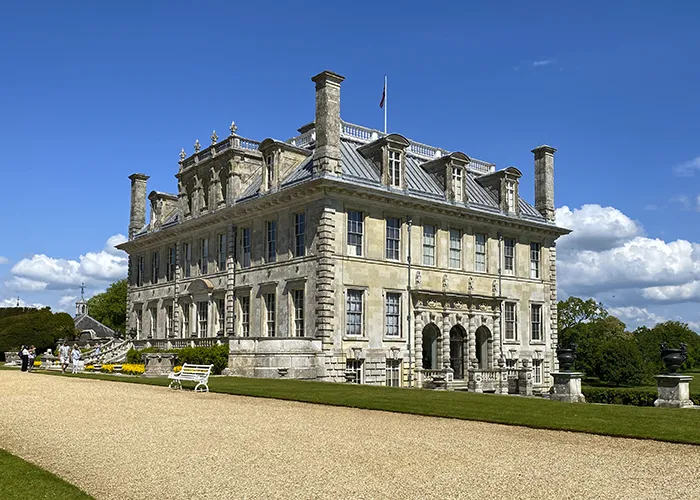
Just beyond Purbeck's borders, near Wimborne Minster, lies the Bankes family's grand reply to the loss of Corfe Castle. With their medieval stronghold ruined by Parliament, Sir Ralph Bankes built a handsome new mansion at Kingston Lacy between 1663 and 1665, designed by Sir Roger Pratt, one of the leading classical architects of the day.
In the 1830s the celebrated Victorian architect Sir Charles Barry, designer of the Houses of Parliament, transformed the house for the great traveller and collector William John Bankes, encasing it in stone and remaking the interiors as a sumptuous Italianate palace. The result is one of the most spectacular country houses in southern England, filled with one of the finest private art collections in the country, paintings by Titian, Rubens, Van Dyck, Velázquez and Sir Peter Lely, alongside Egyptian antiquities and the dazzling gilded-leather Spanish Room.
The house sits at the heart of an 8,500-acre estate of parkland, woodland, ancient farmland and the Iron Age hill fort of Badbury Rings. In 1982, in one of the largest gifts the National Trust has ever received, Ralph Bankes left both Kingston Lacy and Corfe Castle to the Trust, a remarkable bequest from the family who held both for over 300 years.
Dorset Council · Free entry
Durlston Castle
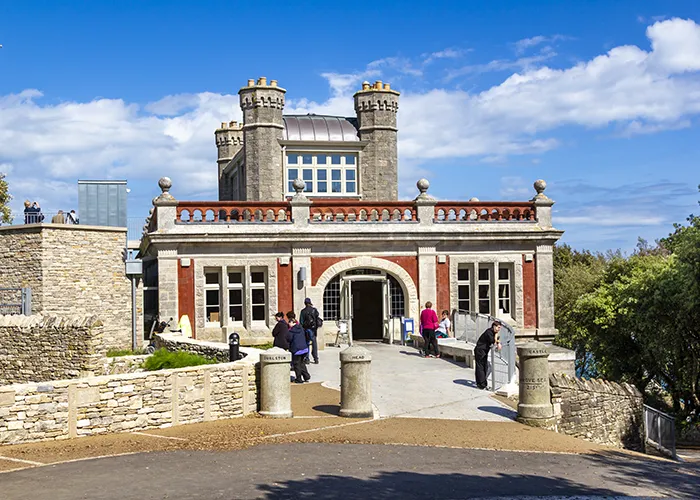
For all its battlements, Durlston Castle never saw a day of war. It is a Victorian folly, built in 1886–87 by the Swanage stone magnate George Burt as the centrepiece of his Durlston Estate. Despite popular descriptions of it as Burt's "private residence," it was actually purpose-built as a refreshment house, a restaurant and visitor draw, for the tourists Burt was working hard to attract to his clifftop estate above the sea.
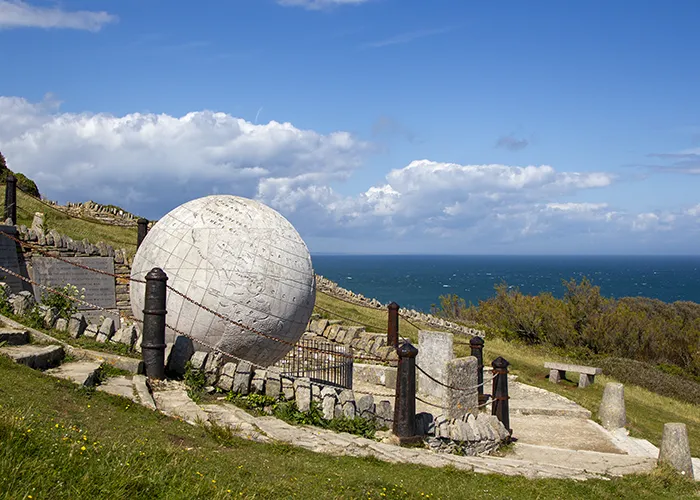
Designed by the Weymouth architect George Crickmay and built entirely of local Purbeck stone, the castle stands above the famous Great Globe and a scatter of carved tablets inscribed with poetry, Bible verses, maps and facts about the natural world, an open-air encyclopaedia in stone. The castle's roof even saw early wireless experiments by Marconi's engineers in the 1890s.
After decades of slow decline it was rescued in a major Heritage Lottery–funded restoration that reopened in November 2011. Today it is free to enter and serves as the visitor centre for Durlston Country Park, with the Fine Foundation Gallery, a Rock Room of Jurassic Coast fossils, the seventhwave café and rooftop terraces with sweeping sea views.
Lulworth Estate · Open
Lulworth Castle
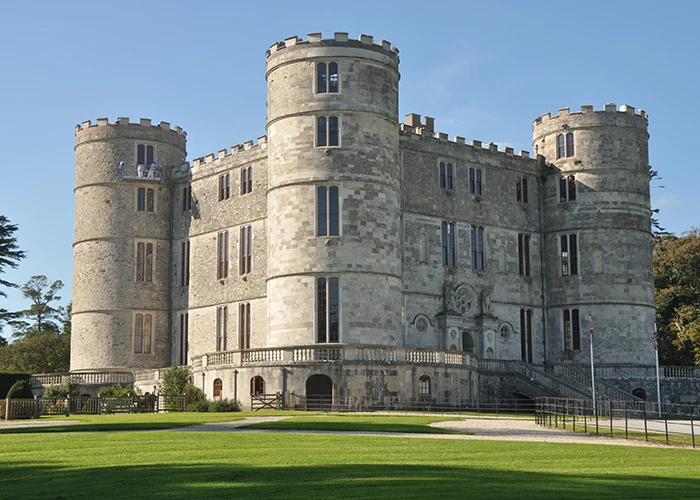
Just west of Purbeck, on the great Weld family estate at East Lulworth, stands one of Dorset's most unusual historic houses. Lulworth Castle is not really a castle either, but a magnificent square hunting lodge of the early 17th century, built to entertain royalty and aristocracy on the Welds' great south Dorset estate.
For three centuries it was the Welds' family seat and the social heart of the estate. Then, in August 1929, a terrible fire gutted the building, leaving only the outer shell standing. After decades of quiet decay it was painstakingly partially restored in a pioneering partnership between the Weld Estate and English Heritage, and reopened to visitors. You can now climb the tower for sweeping panoramic views over the Purbeck countryside and the Jurassic Coast.
In the grounds is the Chapel of St Mary, an exceptionally fine 18th-century building, reputedly one of the first free-standing Roman Catholic chapels built for public worship in England since the Reformation. The estate also contains parkland, woodland walks, the 15th-century Church of St Andrew and a play area, making for a relaxed family day out.
.jpg)
Closed to the public · view from outside
Brownsea Castle
Out in Poole Harbour, just across the water from Studland, stands Brownsea Castle, built between 1545 and 1547 as one of Henry VIII's "Device Forts," part of the chain of coastal artillery forts raised against the threat of French invasion. The original was a stout stone blockhouse with a hexagonal gun platform, garrisoned by Poole townsmen and armed with eight guns. It was held by Parliament during the Civil War and gradually fell out of military use.
In 1726 the architect-politician William Benson converted the old fort into a private residence, and over the following two centuries it was extended, landscaped and rebuilt by a succession of wealthy owners into the country house that stands today. After fires and changes of fortune, the castle and the surrounding island eventually passed to the National Trust.
Today the wider Brownsea Island is one of the most popular nature reserves on the south coast, a sanctuary for red squirrels, seabirds and rare flora, and famously the site of the first Scout camp in 1907. The castle itself, however, is not open to the public: it is leased to the John Lewis Partnership as a private retreat for its staff. Visitors can admire it from outside as they explore the island.
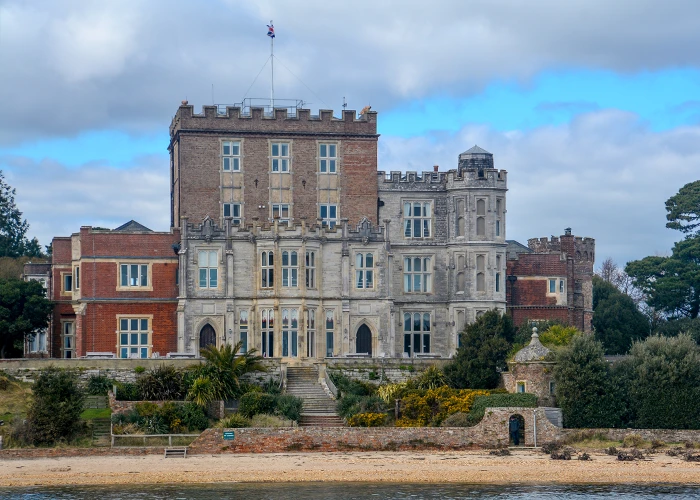
Brownsea Island : Brownsea Castle by Lewis Clarke CC BY

Smedmore · Encombe · Creech Grange
Purbeck's private manors
Beyond the great show-houses, Purbeck has a number of beautiful private manor houses that have been lived in by the same families for generations. Most are not regularly open to the public, but they are part of the area's character and several occasionally open their doors for tours, events or charity open days, keep an eye on the local "what's on" listings.
Smedmore House, set above Kimmeridge Bay, has been the Mansel family home for centuries (and was once part of the Clavell estate that gave the village its Clavell Tower). It is a handsome 17th-century manor of mellow stone, surrounded by gardens, and is sometimes opened for group visits and weddings.
Encombe House sits in a hidden valley north of Kingston, near the south coast. A privately owned Grade II* listed country house built around 1735, with Grade II* listed parkland, it stands at the heart of one of the most beautiful estates in Dorset, but is not generally open to casual visitors. Creech Grange, near Steeple, is the seat of the Bond family, yes, distant cousins of the line said to have given Ian Fleming the name James Bond. The 17th-century house, with later Victorian additions, is also privately owned and only occasionally open.
And it is worth remembering the house that is no longer there: Tyneham House, the manor at the heart of the lost village of Tyneham, was stripped and demolished during the village's wartime military years. Only ghostly footings now remain in the abandoned valley.
Where to go
Where should I start?
For history at its most dramatic, Corfe Castle is unmissable. For sheer grandeur and great art, head to Kingston Lacy. For a free, family-friendly clifftop afternoon, make for Durlston Castle and the Great Globe. Make a day of each, Purbeck's roads are slow and lovely.
At a glance, who looks after what
- National Trust
- Corfe Castle, Kingston Lacy, Brownsea Island (castle privately leased)
- Dorset Council
- Durlston Castle & Country Park, free to enter
- Weld Estate
- Lulworth Castle and the wider East Lulworth estate
- Private homes
- Smedmore House (Kimmeridge), Encombe House (Kingston), Creech Grange (Steeple)
- Lost
- Tyneham House, demolished during the wartime military years
- Free entry
- Durlston Castle; outside of Corfe Castle ruins; Brownsea Castle viewed only from outside
Tips for visiting
- National Trust members get free entry and parking at Corfe Castle and Kingston Lacy, well worth it if you plan to visit both
- Always check opening hours and event days before you set out, many sites operate reduced winter hours, and private houses only open occasionally
- Combine Corfe Castle with the Swanage Railway: the steam-train arrival is one of the great approaches in southern England
- Brownsea Castle itself is closed to the public, but the island around it is a wonderful day out, book the ferry from Poole or Sandbanks in summer
- Durlston Castle is free and family-friendly, a perfect all-weather start or finish to a Purbeck day with the Great Globe and clifftop walks
- For Lulworth Castle, allow a full day to take in the chapel and parkland, and pair it with Lulworth Cove or Durdle Door on the same trip
References & further reading
Sources used for the history, ownership and visitor information added to this page:
- National Trust, Corfe Castle history (Saxon origins, the Norman keep, Bankes family, slighting)
- National Trust, The history of Kingston Lacy (1663–65 build, Barry's 1830s remodelling, the art collection)
- Wikipedia, Kingston Lacy (Sir Roger Pratt, 1982 Bankes bequest, parkland)
- Lulworth Estate, History & Heritage (17th-century hunting lodge, Weld family, 1929 fire, restoration)
- Historic Houses, Lulworth Castle (visiting, the tower, Chapel of St Mary)
- Wikipedia, Brownsea Castle (1545–47 Device Fort, William Benson 1726, John Lewis lease, closed to public)
- Wikipedia, Brownsea Island (NT ownership, JLP lease of the castle, public access to the island)
- Wikipedia, Durlston Castle (Burt, Crickmay, 1886–87, built as a restaurant not a residence)
- Wikipedia, Encombe House (privately owned Grade II* listed, c.1735, near Kingston)
- Wikipedia, The Bankes family (Corfe to Kingston Lacy lineage, 1982 NT bequest)