Durlston Country Park
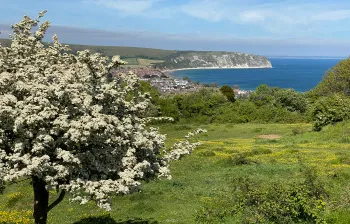
320 acres of clifftop downland and meadow, a National Nature Reserve rich in wildlife.
Explore the park

George Burt's clifftop Victorian folly, never a true fortress, but a restaurant, a stone "encyclopaedia" and now the welcoming gateway to the Jurassic Coast.
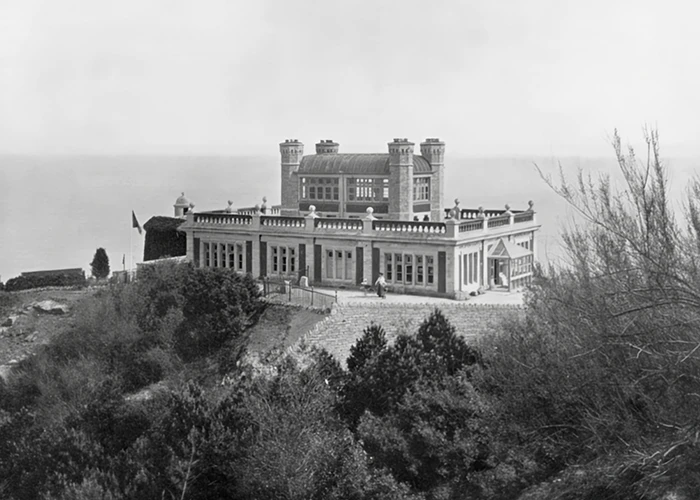
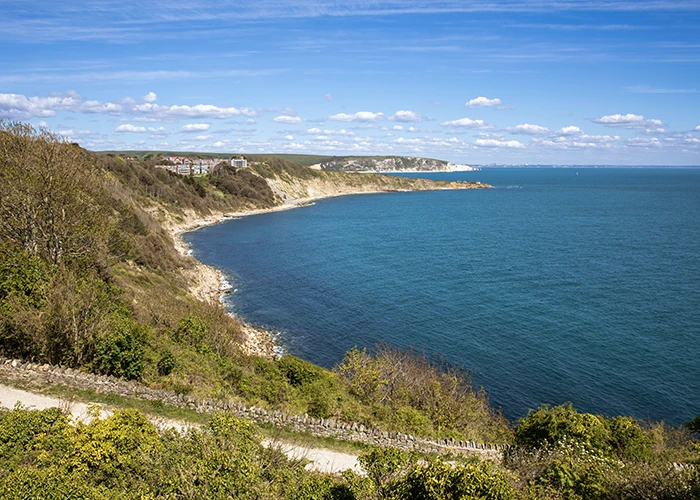
High on the cliffs at Durlston Head, a mile south of Swanage, Durlston Castle commands one of the great views of the Dorset coast, yet despite the battlements and the name, it never saw a single day of war.
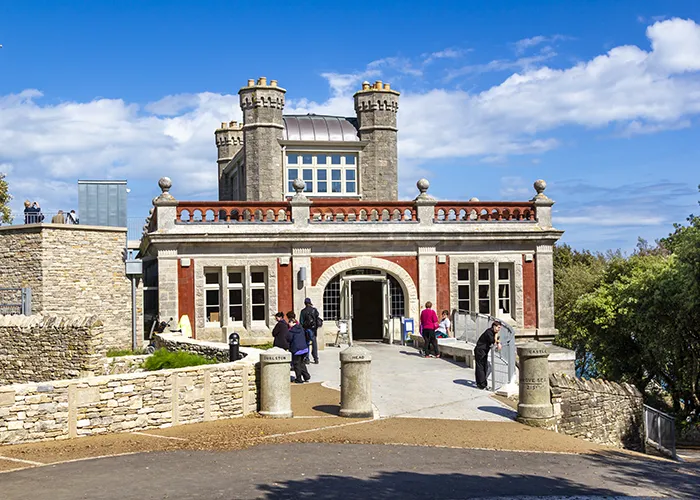
Durlston Castle is a Victorian folly, built in the 1880s by the Swanage stone magnate George Burt as the centrepiece of his Durlston Estate and as a refreshment house for the visitors he hoped to draw to the headland. For over a century it served as a café and restaurant, slowly falling into disrepair, until a major restoration in 2011 brought it gloriously back to life. Today it is the free visitor centre and beating heart of Durlston Country Park and National Nature Reserve, and a designated gateway to the Jurassic Coast World Heritage Site.
Built entirely of local Purbeck stone and ringed with curious carved tablets, cast-iron relics from London and panoramic terraces, the castle is as much an attraction as the country park around it. It is also fully accessible, family-friendly and free to enter, you pay only to park.
The castle was the creation of George Burt (1816–1894), the Swanage-born "King of Swanage," who with his uncle John Mowlem built a fortune shipping Purbeck and Portland stone to London. In 1862 Burt bought a sweep of clifftop land at Durlston Head, quarry ground that supplied their firm, and set about turning it into the "Durlston Estate," a grand visitor attraction intended to help transform Swanage into a fashionable seaside resort.
As the estate's centrepiece he commissioned Durlston Castle. It was designed by the Weymouth architect George Crickmay (1830–1907), in whose office the young novelist Thomas Hardy had earlier worked, and built by W.M. Hardy between 1886 and 1887, entirely of local Purbeck stone. Despite the towers and crenellations, it was never intended as a fortress: it was purpose-built as a restaurant and refreshment house for the visitors Burt hoped to attract to his clifftop estate.
The building passed through many hands after Burt's death, until Dorset County Council bought it in 1973 as part of the new country park. It was given Grade II listed status in 1983, recognising both its architecture and its place in the story of Victorian Swanage.
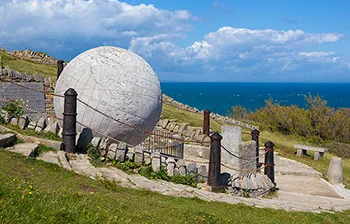
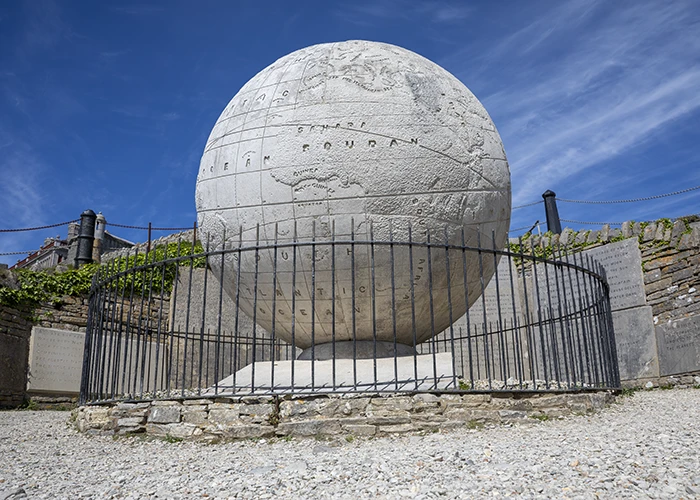
Just below the castle, reached by a flight of steps, sits Durlston's most famous feature: the Great Globe. Carved in 1887 from Portland stone and weighing around 40 tons, this ten-foot (three-metre) sphere is one of the largest stone globes in the world, engraved with a Victorian map of the continents and oceans.
Around the globe and along the surrounding terraces, Burt indulged his passion for learning by turning the estate into a kind of open-air encyclopaedia in stone. Carved tablets are inscribed with quotations from Shakespeare and the Bible, lines of English and Roman poetry, maps of the heavens and the English Channel, and an array of facts and figures about the natural world. On the castle's own side wall, a sundial sits beside two stone tablets giving the comparative clock times and tides of places around the globe.
Even the paths play their part: they are lined with cast-iron bollards salvaged from the streets of London, among them relics from St Martin's-le-Grand, shipped down to Swanage as ballast in Burt's returning stone ships, part of the same instinct that earned the town its nickname "Old London by the Sea."
For all its Victorian whimsy, Durlston Castle has a genuine claim to a place in the history of technology. In the 1890s, the very dawn of radio, a team of the pioneering inventor Guglielmo Marconi's engineers used the castle's roof, perched high above the sea, as a base for some of their early wireless experiments, transmitting signals across the water towards the Isle of Wight.
The high, exposed clifftop that made Durlston such a fine viewpoint also made it an ideal spot for these first tentative steps in long-distance wireless communication. Marconi was working along this stretch of the south coast in the late 1890s, and the castle's brief role is a reminder that this corner of Dorset sat, for a moment, at the cutting edge of a technology that would change the world.
It is a fitting piece of history for a building that now helps visitors connect with the science of the coast and the wildlife around them.
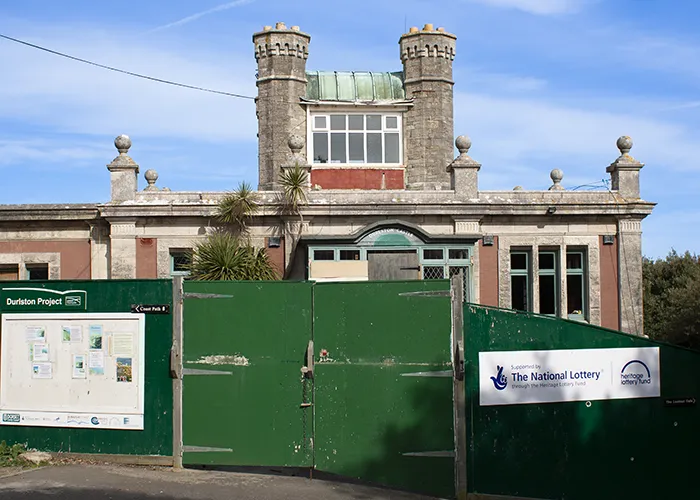
By the early 2000s the castle was in a sorry state. Generations of use and clifftop weather had left it suffering from dry and wet rot and serious structural problems, and the much-loved old building was at real risk. In 2008 a rescue was set in motion with a grant of around £3.23 million from the Heritage Lottery Fund, with a further £2 million raised through fundraising, sponsorship and other grants.
The major restoration ran through 2010 and 2011, with the main building work taking place between April and November 2011. It was a painstaking project, blending traditional crafts, Purbeck stone masonry with lime mortars, terracotta, copper roofing and intricate leadwork, with sensitively designed modern extensions housing a new shop and gallery. The contractors, Greendale Construction, later won the Federation of Master Builders' national award for the UK's best builder in recognition of the work.
The result reopened in November 2011: the historic fabric saved, the Belvedere crowned with a new copper roof, and the whole building cleverly arranged over four levels linked by lifts and gentle ramps so that, despite its cliffside perch, it is accessible to all.
Today the castle is the hub of everything that happens at Durlston. It houses the park's visitor centre, with interactive displays and exhibitions introducing the wildlife, geology and history of the reserve and the wider Jurassic Coast, and a ranger usually on hand to help you plan your visit. The seventhwave café and restaurant serves food and drink with one of the finest sea-view settings in Dorset, and there's a well-stocked shop.
The Fine Foundation Gallery hosts a changing programme of art exhibitions, often themed around wildlife and nature, alongside live music, performance and a permanent Rock Room displaying fossils from the Jurassic Coast. Woven through the building are several specially commissioned artworks: the Timeline, charting four billion years of Earth's history; Diversity, the species of Durlston engraved on glass; and the Walk of Words, some 200 sponsored Purbeck limestone blocks carved with words and phrases.
Crowning it all are the Belvedere and rooftop terraces, with sweeping panoramic views along the coast and out to sea, a spectacular spot to watch for seabirds and passing ships, and an atmospheric venue for events and functions.
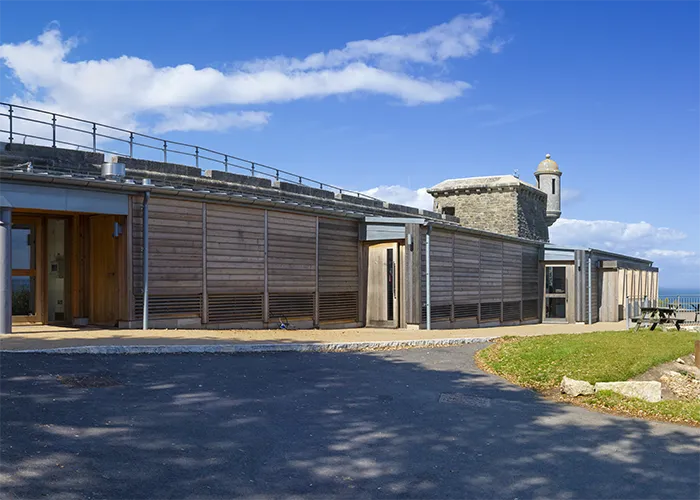
Yes, entry to Durlston Castle, the visitor centre and the gallery is free; you only pay to park. It's open year-round, with the café and exhibitions making it a perfect all-weather start or finish to a walk in the park.
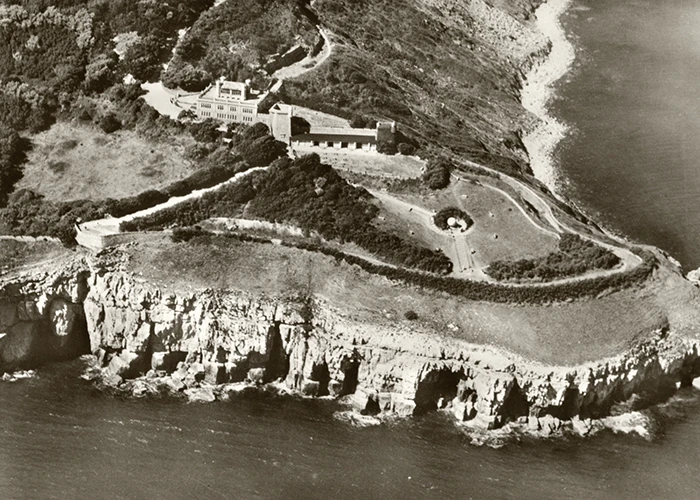
The castle sits at the heart of the country park, with more to explore on every side.
320 acres of clifftop downland and meadow, a National Nature Reserve rich in wildlife.
Explore the park
The 40-ton Portland stone sphere of 1887, ringed with carved tablets, just below the castle.
About the Globe
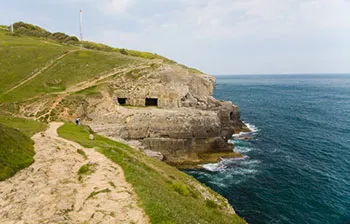
Old cliff-face stone quarries a short walk away, now a bat roost viewed from the coast path.
The quarry story
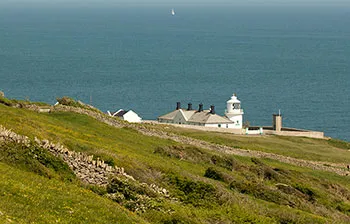
A Trinity House lighthouse of 1881 on the headland just west of the castle.
About the lighthouse
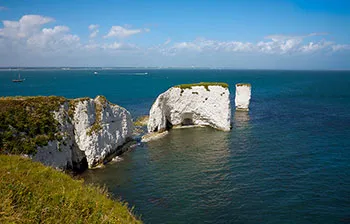
The white chalk sea stacks at the other end of Swanage bay, a walk over Ballard Down.
Visit Old Harry
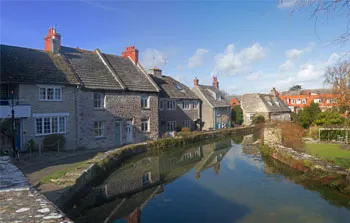
The Victorian seaside town a mile north, full of Burt's "Old London" legacy.
Discover Swanage
Sources used for the history, restoration and visitor information added to this page: