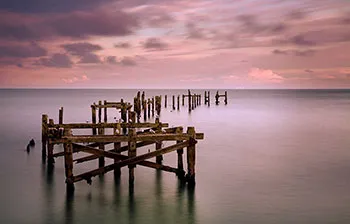
Swanage Pier
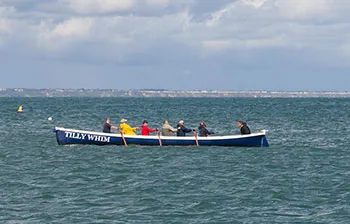
The restored Victorian pier sits right below the gardens, just 0.1 miles away, with diving, fishing, boat trips and a stroll over the water.

Landscaped seafront gardens above Swanage Bay, with an open-air amphitheatre, two listed Georgian columns, the town's Victorian Prince Albert obelisk and a quiet sanctuary garden. The last green slope on the seafront.
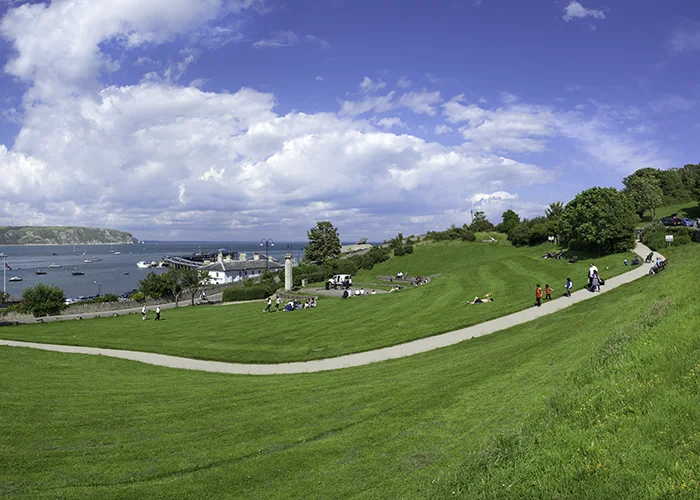
Prince Albert Gardens is a gently sloping public garden at the southern end of Swanage seafront, overlooking the bay and the Victorian pier. It is the last surviving piece of open green along the seafront, and its landscaping deliberately forms a gradual transition from the edge of town to the wilder downland and coast path beyond.
The gardens occupy a hillside between the High Street and the foot of the Downs, a few steps from Swanage Pier and the Broad Road car park. The site rises gently away from the water, so almost every part of it commands a view: across the bay to Ballard Down and the chalk cliffs, out to the pier and the moored pleasure boats, and on a clear day across to the Isle of Wight.
For somewhere so close to the centre of a busy resort, the gardens are a notably calm place. Families spread out for picnics on the grass, walkers pause at the top of the slope before joining the coast path to Peveril Point and Durlston, and the small amphitheatre at the centre fills with people whenever there is a performance. The gardens pack a surprising amount of Swanage history into a compact space, with a set of listed Georgian columns, a Victorian royal memorial and a modern memorial garden all within a few minutes' walk of one another.
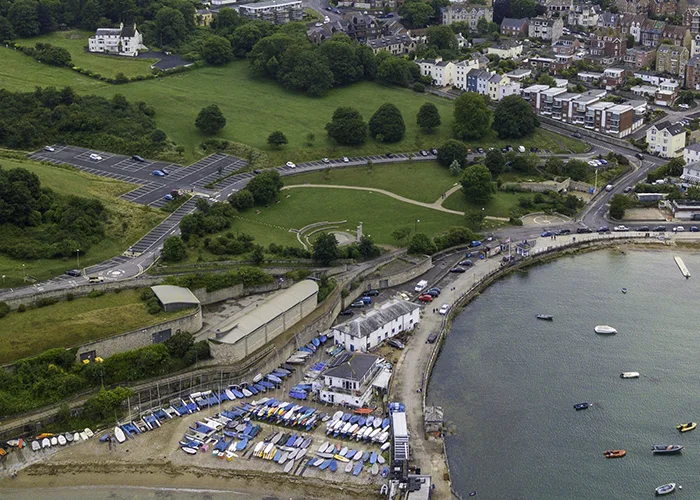
The slope was originally open grazing land at the southern end of the bay, and for many years in the twentieth century it was a miniature golf course, remembered by older residents as a pitch-and-putt that ran across the hillside. When the golf course closed, the site was earmarked for a public park as part of the Swanage Seafront Improvement Scheme, and the gardens were laid out and opened in 1996.
The design treats the gardens as a hinge between the town and the open coast. At the bottom the planting is formal and ornamental, close to the promenade and the pier. As the ground rises it loosens into rougher grass and informal slopes that lead the eye, and the walker, towards the Downs and the South West Coast Path. The scheme made careful use of local Purbeck and Portland stone throughout, and in 1997 the project received a commendation at the Civic Trust Awards for the quality of its design and detailing.
The gardens take their name from Prince Albert, the consort of Queen Victoria. Albert and his eldest son, the future King Edward VII, visited Swanage briefly in 1856, and the prince is said to have come ashore from the royal yacht near Peveril Point before climbing up to enjoy the view. The hillside that became the gardens overlooks the spot, which made it a fitting place to carry the prince's name and, decades later, to give a permanent home to the town's memorial to him.
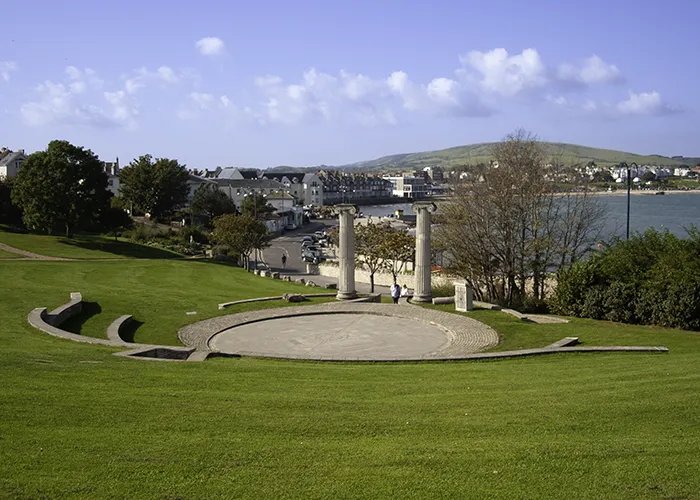
The centrepiece of the gardens is a small open-air amphitheatre, with curved tiers of seating built into the slope around a pair of tall stone columns. The two Ionic columns are made of Portland stone and date from the early nineteenth century. They are designed in the classical style, modelled on the ancient Greek temple of Athena Polias, and they originally adorned a building in London before making their way to Swanage.
For most of the twentieth century the columns stood in the forecourt of the Grosvenor Hotel, the grand seafront hotel that once dominated this part of Swanage. When the hotel was demolished in the late 1980s the columns were saved, and they were given a new setting at the heart of the gardens when the amphitheatre was built around them in 1996. The columns are Grade II listed, which is why they survived the demolition that swept away the rest of the hotel.
The amphitheatre is often used by event organisers through the summer. Its tiered grass and stone seating, the columns as a natural backdrop and the bay beyond make it a fine setting for outdoor performances, music and community events. When nothing is on, it is simply a sheltered, sunny spot to sit with the view.
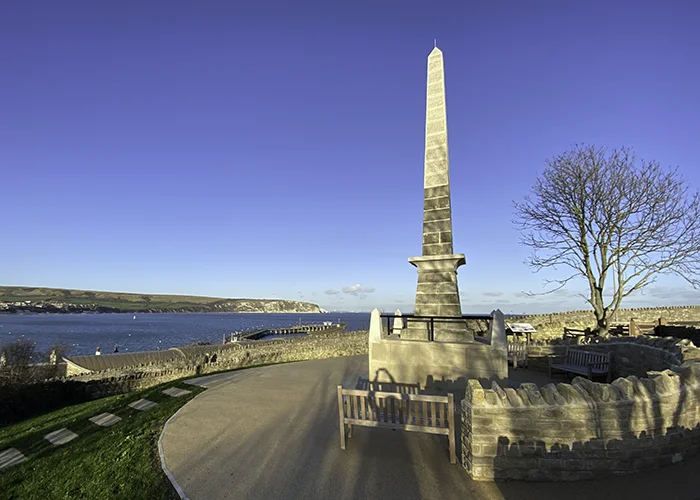
At the eastern end of the gardens stands a Purbeck stone obelisk, the Prince Albert Memorial. It has a remarkable claim: it was the first civic memorial to Prince Albert erected anywhere in Britain. The grander memorials at Manchester (1865) and Kensington came later. Swanage got there first, in 1862.
The obelisk was the idea of George Burt, the Victorian businessman and benefactor behind much of modern Swanage, including Durlston Castle and the Town Hall. Four weeks after Prince Albert died at the age of 42 in December 1861, Burt wrote to the Rector of Swanage, the Reverend Duncan Travers, proposing that the town erect an obelisk of native stone with a short inscription, paid for by public subscription. The townspeople duly raised the money, a considerable effort for a place of only around two thousand people, and the memorial was built of Purbeck stone and modelled on an obelisk Burt knew at Ludgate Circus in London.
The obelisk originally stood at the junction of Court Hill and the High Street, near the present Royal British Legion, welcoming visitors into the town. It survived at full height into the 1920s, but by the 1930s the upper tiers had been lost and it had been truncated. In 1971, with the site needed for development, the monument was taken down on the promise that it would be re-erected elsewhere. That promise went unfulfilled for half a century, and the Purbeck stone blocks ended up in storage at a Worth Matravers quarry.
In 2021, after fifty years and several failed attempts, the obelisk was finally rebuilt in Prince Albert Gardens. The project was coordinated by the Swanage and Purbeck Development Trust with Swanage Museum and paid for by a private benefactor, Mike Sloggett. Local stonemasons cleaned and repaired the original blocks and cut new stone to replace what had been lost, and the restored memorial now stands in a commanding position overlooking the bay, close to where the prince is said to have come ashore in 1856.
The gardens hold more than the columns and the obelisk. Standing among the planting is the Lady of the Rocks, a sculpture carved in Purbeck freestone in 1996 and 1997 by Mary Spencer Watson, one of the most respected sculptors the Isle of Purbeck has produced. Spencer Watson lived and worked at Dunshay Manor near Worth Matravers, where as a girl she had watched the local quarrymen working the stone and decided to become a carver. Her work appears at Wells Cathedral and elsewhere, and this piece roots the gardens firmly in the Purbeck stone tradition.
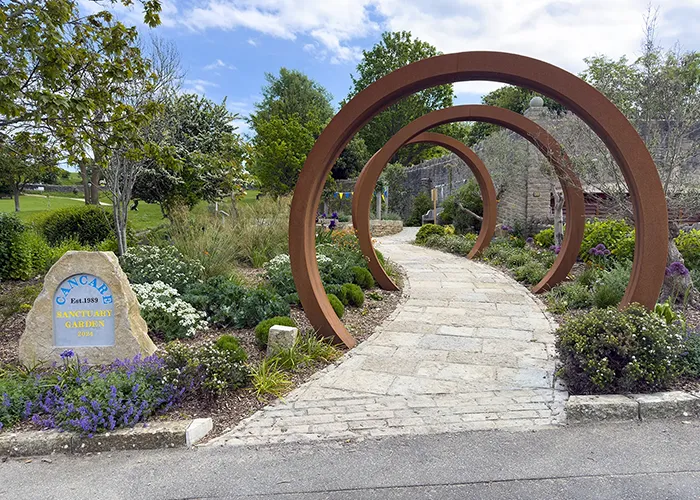
In a quiet corner of the gardens is the Cancare Sanctuary Garden, opened in May 2024 to mark the 35th anniversary of Cancare, the Swanage-based cancer support charity. It was funded by a legacy from local residents Margaret and Ian Crofts, designed by the RHS Chelsea garden designer Michelle Brown and built by Wycliffe Landscapes. Laid out with Purbeck stone and sculptural moongates, and framed by panoramic views over the bay, it was created as a space for reflection and remembrance, open to everyone, and as a lasting tribute to those affected by cancer.
The gardens sit right on the seafront beside Swanage Pier, with the museum, the lifeboat station and the town centre all within a short, level walk. They make an easy stop on any walk along the front or up onto the coast path.
The restored Victorian pier sits right below the gardens, just 0.1 miles away, with diving, fishing, boat trips and a stroll over the water.
The gardens lead straight up to The Downs and the coast path towards Peveril Point and Durlston, 0.1 miles away.
The Museum and Heritage Centre, 0.2 miles away, tells the story of George Burt and the town, including the Albert Memorial.
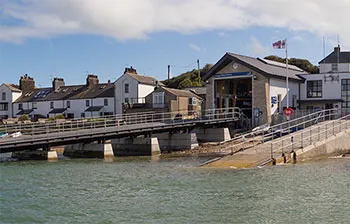
The RNLI lifeboat station at Peveril Point is a short walk along the seafront, 0.2 miles from the gardens.
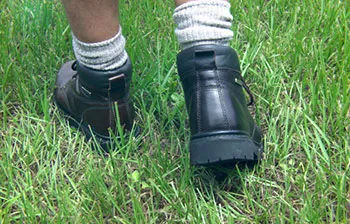
The gardens are on the South West Coast Path. Walk east to Peveril Point and Durlston, or back along the bay to the beach.
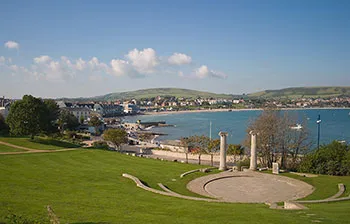
Discover more of the green spaces around Swanage, from seafront gardens to the wider Purbeck countryside.
Sources used to verify and expand the information on this page: