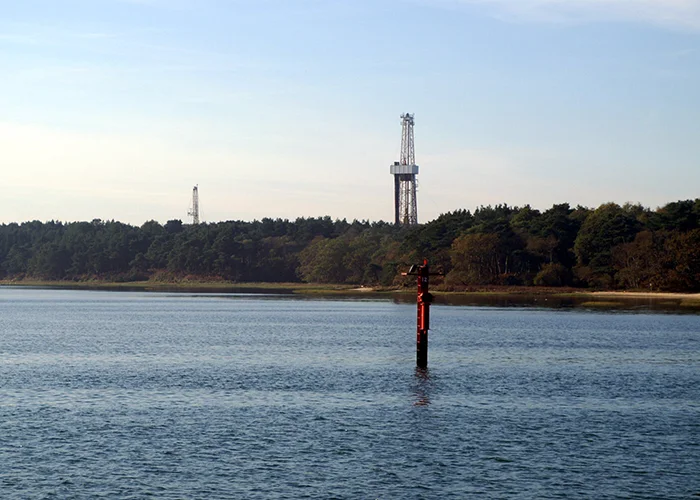

Kimmeridge Oil Field
Discovered 1959; beam pump in continuous operation since 1961, Britain's oldest working pump. Output ~65 bpd.
More on Wikipedia

From hand-worked oil shale at Kimmeridge in the 1600s to the largest onshore oilfield in Western Europe, a hidden industrial history beneath one of Britain's most scenic landscapes.
Purbeck has been extracting oil for longer than almost anywhere else in Britain, and today it conceals the largest onshore oilfield in Western Europe, almost entirely hidden from view in Rempstone Forest.
To most visitors, the Isle of Purbeck appears to be an entirely natural landscape of rolling chalk downland, heathland, dramatic coastline and ancient woodland. Few would guess that beneath their feet lies an enormous reservoir of crude oil, or that Purbeck has been associated with petroleum extraction since the early seventeenth century. The story of oil in Purbeck spans four hundred years and covers everything from medieval oil shale used for ornamental carving to a modern onshore oilfield that has yielded hundreds of millions of barrels of crude oil from rocks deep beneath Poole Harbour and Poole Bay.
The Kimmeridge Bay area has the longest association with petroleum extraction in Purbeck. The dark bituminous shale that outcrops here, known as "Kimmeridge oil shale" or "blackstone", was exploited as a fuel and even carved into bracelets and furniture in Roman and pre-Roman times. By the early seventeenth century it was being burned as a fuel and distilled for oil, though early attempts to commercialise production on a large scale failed.
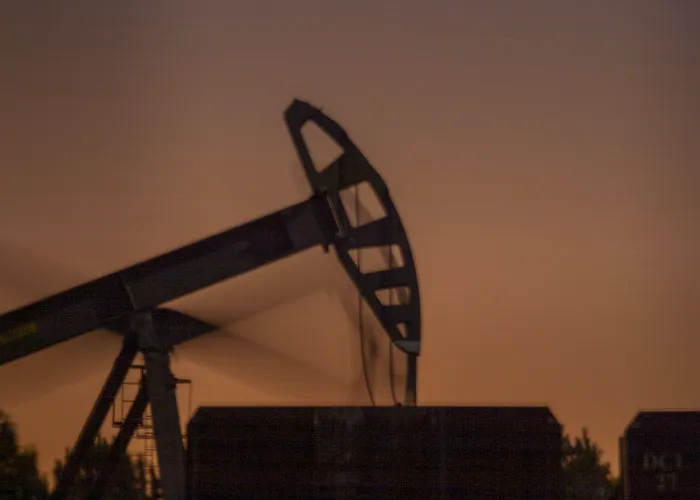
Modern oil exploration at Kimmeridge began in earnest in 1936 when BP drilled experimental boreholes in the area. The Kimmeridge Oil Field itself was formally discovered around 1959 (some sources cite 1960 as the year of the significant BP discovery), and a beam pump, the iconic "nodding donkey", has been extracting oil from the site continuously since 1961. This makes it the longest-running operational beam pump in the United Kingdom.
The pump draws oil from a depth of approximately 350 metres below the base of the cliff and currently yields around 65 barrels per day. The oil is transported by road tanker to Wytch Farm, where it is processed and then piped via an underground pipeline to storage tanks near Hamble on Southampton Water. The nodding donkey, painted to blend into its surroundings, remains a distinctive sight on the clifftop above Kimmeridge Bay.
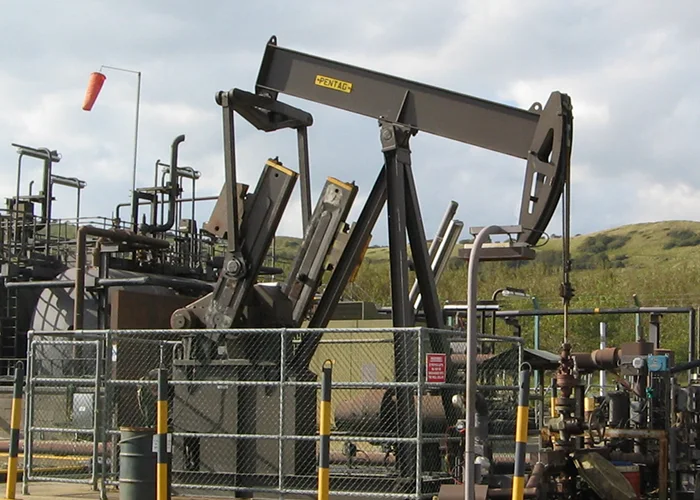
The Wytch Farm oil and gas processing facility, located in Rempstone Forest about two miles from Corfe Castle, sits at the centre of the largest onshore oilfield in Western Europe. Most visitors to the area pass within a few miles of it without ever realising it exists, thanks to deliberate screening with conifer plantations and design that keeps buildings as low as possible; even the metalwork is painted reddish-brown to blend with the trees.
The oilfield was first discovered in 1973 by British Gas Corporation (then state-owned), which struck liquid oil at the site now called the Bridport reservoir, lying around 900 metres beneath the surface. Production started in 1979 at modest levels. BP took over as operator in 1984 following the privatisation of British Gas, and the field's true extent became apparent as further reservoirs were located. The much larger Sherwood reservoir, now the dominant source of oil, lies at around 1,600 metres depth in Triassic Sherwood Sandstone, and was discovered in 1978. A third reservoir, the Frome, sits at roughly 750 metres in shelly limestone.
The field's production grew dramatically through the 1980s and 1990s, reaching its peak of 110,000 barrels per day in 1997, by which time it was producing more oil per day than some entire OPEC member states. BP developed innovative extended-reach drilling technology at Wytch Farm to access oil lying beneath the environmentally sensitive waters of Poole Harbour and Poole Bay from well sites entirely on land, techniques that were subsequently exported worldwide.
By 2002 production had declined to around 50,000 barrels per day, and BP sold its 67.8% interest in the field to French company Perenco in 2011. Perenco, which now holds a 95% interest after acquiring the remaining share from Premier Oil in 2017, continues to operate the field. Current output is approximately 13,500–14,000 barrels per day (as of 2019–2020 figures). The field's life has been extended multiple times and was expected to continue production to around 2037.
The Wytch Farm oilfield is structurally complex, consisting of three separate oil reservoirs within different rock formations. The Bridport reservoir sits in Jurassic Bridport Sands at around 900 metres depth beneath Poole Harbour. The larger Sherwood reservoir, which accounts for around 90% of the total recoverable oil, is in Triassic Sherwood Sandstone at roughly 1,600 metres depth and extends eastward under Poole Bay. The Frome reservoir occupies a shelly limestone at approximately 750 metres depth.
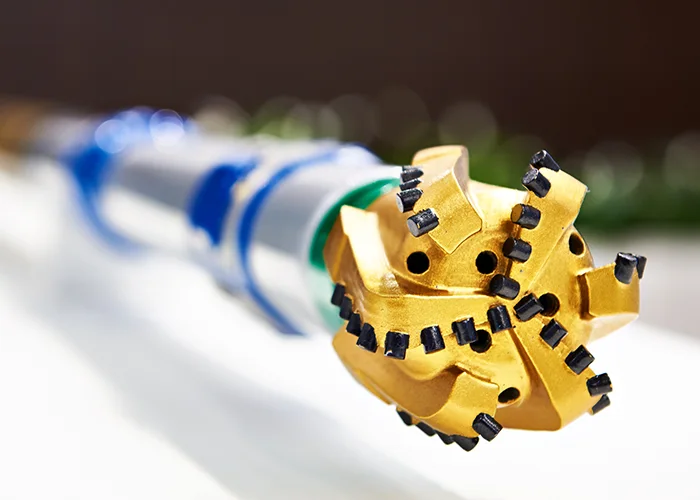
The field extends eastwards from the Goathorn Peninsula into Poole Bay, stretching approximately 10 kilometres (6.2 miles) under the sea. Rather than place drilling platforms in the harbour or bay, which would have been environmentally and visually unacceptable, BP pioneered extended-reach horizontal drilling from onshore well sites. Wells were drilled at angles of up to 80° from vertical over distances of up to 10 kilometres, a world record at the time. This technology allowed the entire sub-sea portion of the field to be reached from a small number of carefully screened land sites.
The oil extraction method used is described as "water injection" (also sometimes called waterflooding), in which seawater is pumped into the reservoir to maintain pressure and push oil towards the production wells. The oilfield also includes a sea water pumping station connected by underground pipelines. Processed crude oil travels via a 93-kilometre underground pipeline to storage and loading facilities near Hamble on Southampton Water.
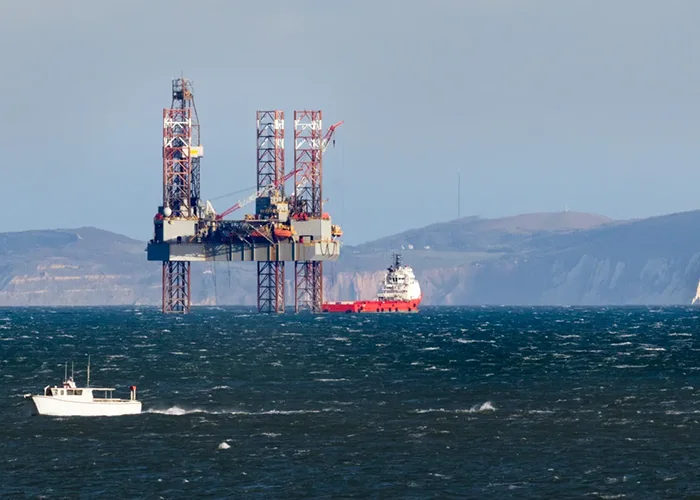
In 2019, Corallian Energy were granted a licence to drill an exploratory well in Poole Bay to search for additional oil in the Sherwood Sandstone. The jack-up drilling rig Ensco-72 was positioned approximately four miles off Studland Bay in February 2019. On 25 February 2019, the Colter well (reference 98/11a-6) was drilled vertically to a total depth of 1,870 metres into the Sherwood Sandstone. Oil and gas were encountered, with an estimated mean recoverable volume of around 15 million barrels, a significant discovery. If developed, the oil would be extracted using horizontal wells drilled from the existing Wytch Farm site onshore.
In March 2023, the field received unwanted national attention when a pipeline failure allowed crude oil to escape into a watercourse draining towards Poole Harbour. Approximately six tonnes of oil in a 15% oil / 85% water mixture entered the water, prompting a major incident declaration and a significant clean-up operation. The incident caused serious concern for the protected habitats of Poole Harbour, including nesting birds on Brownsea Island and shellfish beds. Perenco carried out remediation work, and the incident led to renewed public scrutiny of the field's environmental safeguards.
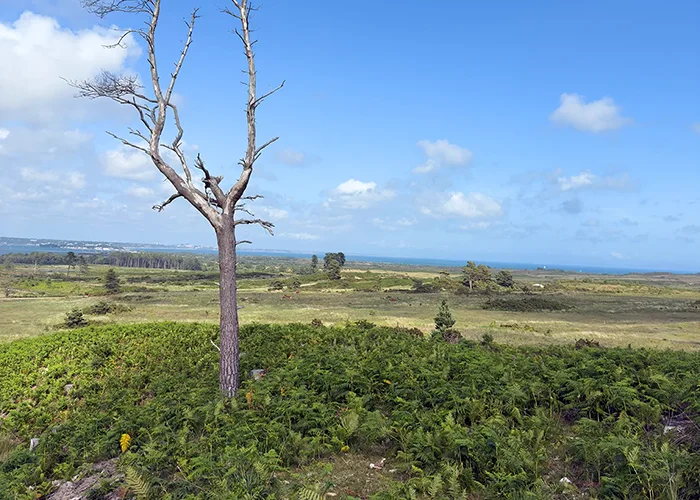
Such was the care taken at Wytch Farm that the structures are sunk below the surrounding terrain, painted to match the trees, and screened by conifer plantations. Most Purbeck visitors never know it is there.
Key facts about the three active oilfields of the Wessex Basin that lie wholly or partly in Purbeck.
Discovered 1959; beam pump in continuous operation since 1961, Britain's oldest working pump. Output ~65 bpd.
More on Wikipedia
Western Europe's largest onshore oilfield. Discovered 1973; peak output 110,000 bpd (1997); now ~13,500 bpd.
More on Wikipedia
Discovered in 1964; a smaller field near Wareham whose production is piped to Wytch Farm for processing.
More on Wikipedia
Home to the nodding donkey pump and an exceptional rock platform popular with snorkellers and geologists.
Explore Kimmeridge
The Wytch Farm oil facility is just a couple of miles from the dramatic ruins of Corfe Castle, visible from the same ridge.
Discover Corfe Castle
Purbeck's other great extractive industry, stone quarrying, has shaped the landscape and buildings of the Isle for over 2,000 years.
About quarrying
Sources used to verify and expand the information on this page: