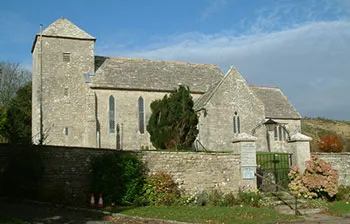
Church Knowle
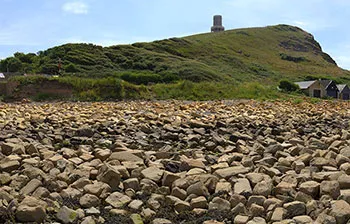
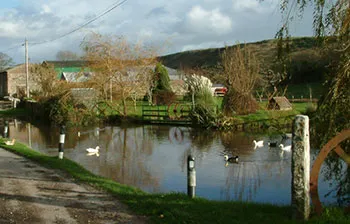
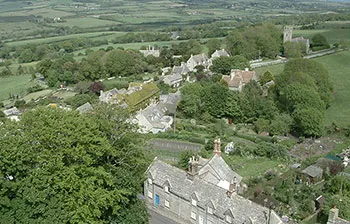
A neighbouring Purbeck village sharing part of Steeple's medieval manor history, with its own ancient church.
Explore Church Knowle

A scatter of stone cottages, a manor house and an ancient church tucked beneath the Purbeck Hills, with a remarkable thread linking it all the way to George Washington.
Steeple is one of the smallest and most secluded settlements on the Isle of Purbeck, lying about four miles south west of Wareham, between Corfe Castle and Lulworth, at the foot of the chalk ridge of the Purbeck Hills.
Today Steeple amounts to little more than a handful of limestone cottages, a manor house and a small medieval church standing among trees, reached along narrow lanes that wind through the fields and farmland of this part of Purbeck. It is easy to drive straight past, yet this tiny hamlet has a history out of all proportion to its size, with links stretching from the Domesday Book to the founding family of the United States of America.
The parish takes in the surrounding fields, the hamlet of West Creech, and the wooded slopes leading up to Creech Barrow, a distinctive conical hill that has long been a landmark for travellers crossing this stretch of Dorset. The whole area sits within the Dorset National Landscape, prized for its mix of chalk downland, heath and historic estates.
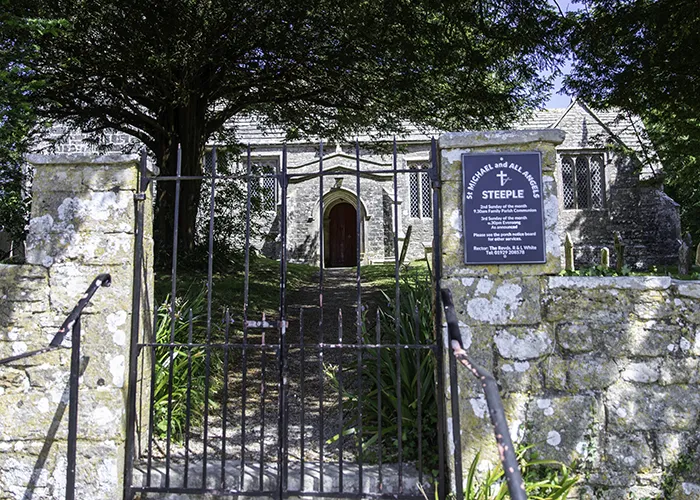
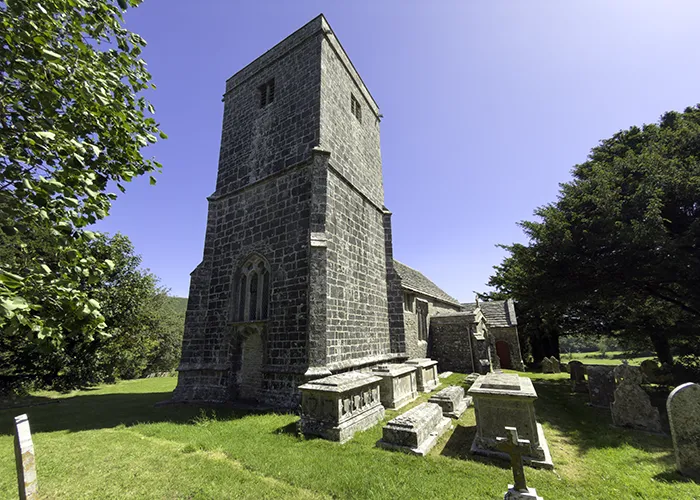
At the heart of the hamlet stands the small church of St Michael and All Angels, a Grade I listed building whose origins go back to the 12th century. Much of the original Norman stonework survives in the walls of the nave, which were heightened in the 15th century, and the building is roofed in traditional Purbeck stone slabs.
Despite its name, the church does not actually have a steeple. Local tradition holds that the village name comes from the Dorset word for a steep place, describing the church's position on rising ground rather than any spire. A complete view of the church from the south is largely hidden by ancient yew trees, though the north side gives a clearer impression of its age and simple proportions.
The earliest recorded rector was John of Gloucester, instituted in November 1222 in the reign of King Henry III, a reminder of just how long this small church has served the surrounding farms and cottages. After years of wartime neglect during the Second World War, the church was restored and reopened in 1954 following a public appeal.
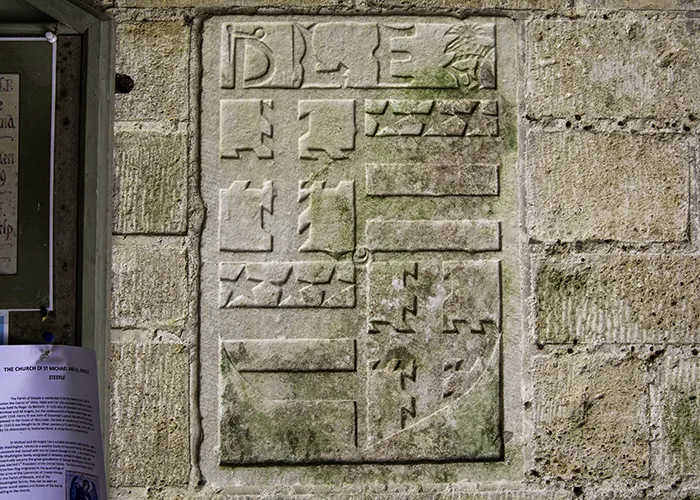
Steeple's most remarkable claim to fame lies inside the porch of its little church. Carved in stone, and repeated in the barrel roof, is the coat of arms of the Lawrence family, who held the manor here for generations. The design, of bars and mullets, or stars, is strikingly similar to the stars and stripes of the flag of the United States, and to the coat of arms on a signet ring once belonging to George Washington himself.
The connection runs through marriage. In 1390 Edmund Lawrence married Agnes de Wessington, linking the Lawrence and Washington families of Lancashire. Generations later, Sir Oliver Lawrence settled at Steeple and built Creech Grange, while a descendant of Agnes, John Washington, emigrated to Virginia. His great-grandson was George Washington, who became the first President of the United States.
It is a striking thought that the heraldry on display in this tiny Dorset church may have helped inspire the design of one of the most famous flags in the world, making Steeple a small but genuine point of pilgrimage for American visitors tracing the roots of the Washington family.
A little to the north of the hamlet, beneath the wooded slopes of the Purbeck Hills, stands Creech Grange, a handsome manor house with a history reaching back to the Dissolution of the Monasteries. Before the Reformation this land belonged to Bindon Abbey, but when Henry VIII dissolved the monasteries in the late 1530s, Sir Oliver Lawrence acquired the estate and built Creech Grange, completing the house shortly before his death in 1559.
When the Lawrence line died out, the house passed in 1691 to Nathaniel Bond, beginning a long association between the Bond family and this part of Purbeck that lasted for centuries. The Bonds went on to make a significant mark beyond Dorset too, with Thomas Bond, made a baronet by Charles II, later developing an area of London that became known as Bond Street.
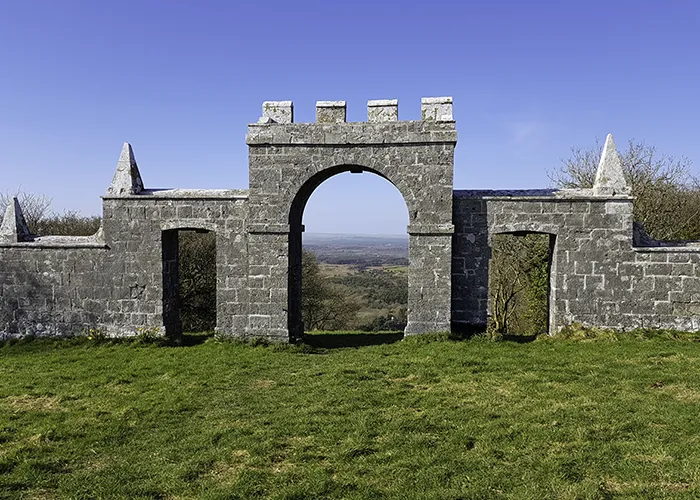
The grange itself was badly damaged during the Civil War and substantially rebuilt by the Bond family in 1846, while a private chapel dedicated to St John the Evangelist, built in the 18th century, stands nearby. High on the ridge above, the striking arch known as Grange Arch was built as an eye-catching landmark in the view from the house, and remains a well-known feature on the skyline above Steeple to this day.
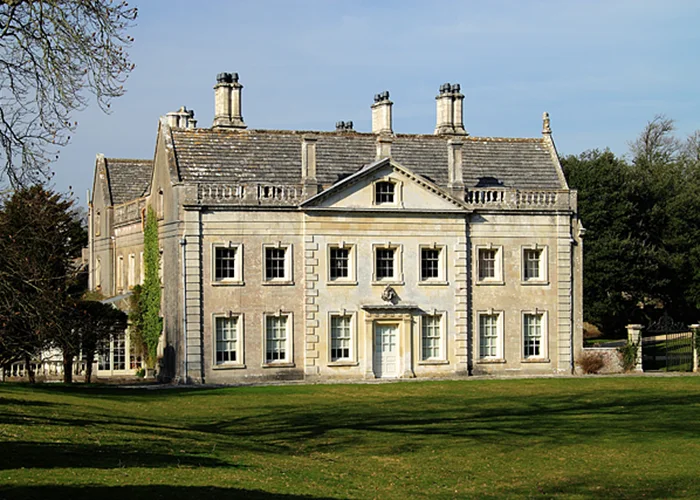
Mike Searle / Creech Grange / PhotoCC BY-SA 2.0
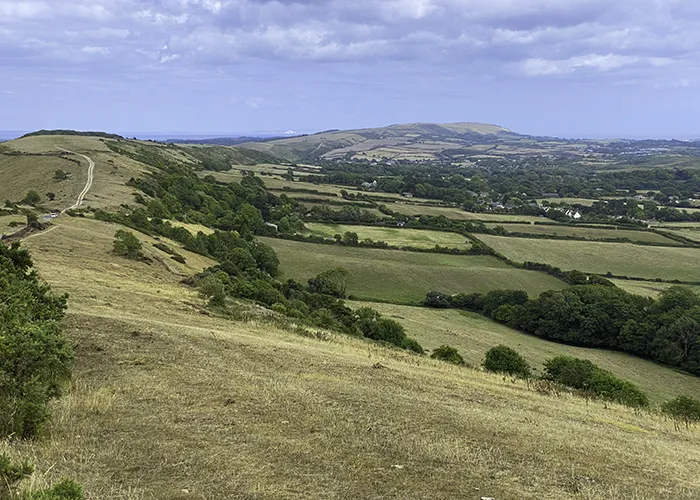
Steeple makes an excellent, peaceful starting point for walks across this little-visited corner of Purbeck. Footpaths lead out across pasture and heathland towards Steeple Leaze, climbing gently onto the ridge of the Purbeck Hills, from where there are fine views over Creech Barrow and south towards Clavell Tower and Kimmeridge Bay on the coast.
Routes also lead up towards Grange Arch and along the ridge above Creech Grange, giving walkers a chance to look down on the estate and its parkland from above, before dropping back through farmland to the church. Some paths in the wider area run close to the Lulworth firing ranges, so it is worth keeping an eye on waymarking and any range warning signs when planning a walk.
Because Steeple is so small, with no shop, pub or visitor facilities of its own, it suits visitors who enjoy exploring on foot and are happy to bring everything they need with them. Parking is limited to a few spaces near the church, so it is best treated as a quiet stop on a longer day out around the heaths and villages of Purbeck.
Steeple itself has no shop, pub or café, so it's best visited as part of a longer walk or drive around Purbeck. Pack a picnic, enjoy the peace of the churchyard, and combine your visit with nearby Wareham or Corfe Castle for refreshments.
Other places within easy reach that make a natural pairing with a visit to this quiet hamlet.
A neighbouring Purbeck village sharing part of Steeple's medieval manor history, with its own ancient church.
Explore Church Knowle
The famous abandoned village, whose living was once held jointly with Steeple's own parish.
Discover Tyneham
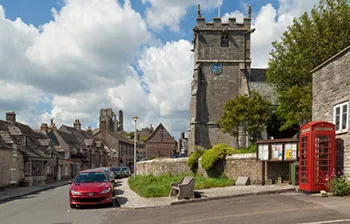
The dramatic ruined castle and stone village a short drive to the north east, in the gap of the Purbeck Hills.
Discover Corfe
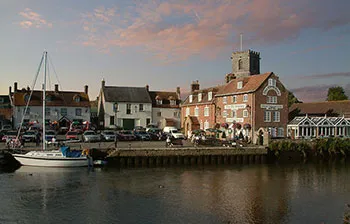
The historic Saxon walled town on the River Frome, the nearest place for shops, pubs and supplies.
Explore Wareham
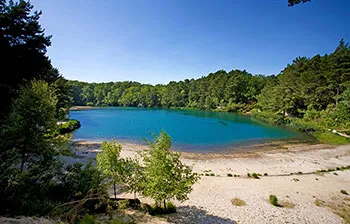
A former clay pit with shimmering blue green waters and woodland walks, a short drive away.
Visit Blue Pool
Ridge paths above Creech Grange link Steeple to Kimmeridge Bay and Clavell Tower on the coast.
Plan a walk
Sources used for the history and visitor information added to this page: